
Context Matters: Evaluating Domain Constraints on Critical Thinking
Keywords:
Critical thinking skills, content dependency, transfer of learning, context specificity, science educationAbstract
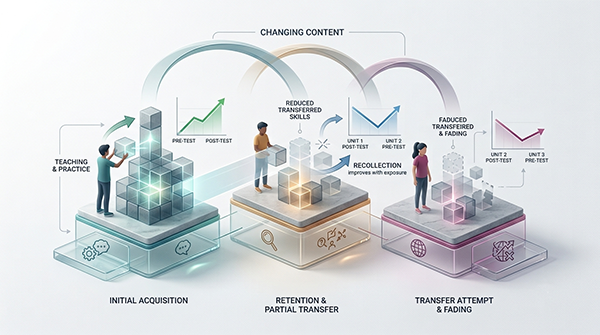
Critical thinking skills allow students to reflect on their understanding by giving a substantial argument supported with proof for complex problems, not only in class but also in real-life situations. Critical thinking skills can be taught at different grade levels by embedding them within the content of any subject. However, there is no guarantee that the critical thinking skills, once learned within the framework of one subject, can be universally applied when the subject or the content changes. Therefore, the foremost aim of this study is to determine whether and to what extent critical thinking skills learned in one context can be transferred to another context. An intact class of grade 7 science students was taught three units from science textbooks. A pre-test, post-test technique was employed to record 'changes in critical thinking skills' at the end of each unit. After the intervention, post-test scores at the end of each unit were compared with the pre-test scores of the next unit to assess the transferability of critical thinking skills. There is insufficient evidence of the transferability of critical thinking skills when the content to be taught changes. Retention of critical skills, once learned, apparently fades when it is exposed to a new situation, but recollection improves with every exposure.
References
Alsaleh, N. J. (2020). Teaching critical thinking skills: Literature review. Turkish Online Journal of Educational Technology, 19(1), 21-39.
Bailin, S. (2002). Critical thinking and science education. Science & Education, 11(4), 361–375.
Barnett, S. M., & Ceci, S. J. (2002). When and where do we apply what we learn? A taxonomy for far transfer. Psychological Bulletin, 128(4), 612-637.
Bosch, E., Seifried, E., & Spinath, B., 2021. What successful students do: Evidence-based learning activities matter for students' performance in higher education beyond prior knowledge, motivation, and prior achievement. Learning and Individual Differences, 91(2), 102056.
Brown, A. L. (1990). Domain-specific principles affect learning and transfer in children. Cognitive Science, 14, 107 – 133.
Changwong, K., Sukkamart, A., & Sisan, B. (2018). Critical thinking skill development: Analysis of a new learning management model for Thai high schools. Journal of International Studies, 11(2), 37-48.
Crain, W. C. (2005). Theories of development: Concepts and applications (5th ed.). Upper Saddle River, NJ: Pearson Education.
Darling-Hammond, L., Flook, L., Cook-Harvey, C., Barron, B. & Osher, D. (2019). Implications for educational practice of the science of learning and development, Applied Developmental Science, DOI: 10.1080/10888691.2018.1537791
Davies, M. (2013). Critical thinking and the disciplines reconsidered. Higher Education Research Development. 32, 529–544.
Dumitru, D. (2013). The transfer and the transferability of critical thinking. Transylvanian Review, 22(3), pp. 142-148.
Dunn, D. S., Halonen, J.S., & Smith, R. A. (2009). Engaging minds: Introducing best practices in teaching critical thinking in psychology. In D. S. Dunn, J. S. Halonen, & R. A. Smith (Eds.), Teaching critical thinking in psychology: A handbook of best practices (pp. 1-8). Hoboken, NJ: Wiley-Blackwell.
Emerson, M. K. (2013). A Model for Teaching Critical Thinking. Online Submission. Available at: https://files.eric.ed.gov/fulltext/ED540588.pdf
Ennis, R. H. (1989). Critical thinking and subject specificity: Clarification and needed research. Educational Researcher, 18(3), 4–10.
Ennis, R. H. (2013). ‘Critical thinking across the curriculum.' Virtues of Argumentation (OSSA), 22 – 25 May. Windsor, ON: OSSA, pp. 1 - 16
Gelder, T. V. (2005). Teaching Critical Thinking: Some Lessons from Cognitive Science. College Teaching, 53(1), 41-48 http://dx.doi.org/10.3200/CTCH.53.1.41-48.
Halpern, D. F. (2009). Foreword. In D. S. Dunn, J. S. Halonen, & R. A. Smith (Eds.), Teaching critical thinking in psychology: A handbook of best practices (pp. xv-xvi). Hoboken, NJ: Wiley-Blackwell.
Hughes, C. (2014). Theory of knowledge aims, objectives and assessment criteria: An analysis of critical thinking descriptors. Journal of Research in International Education 13(1). 30-45
Kurfiss, J. G. (1988). Critical thinking: Theory, research, practice, and possibilities (Report No. 0-913317-44-6). Washington, DC: Association for the Study of Higher Education.
Lai, E. R. (2011). Critical thinking: A literature review. Research Report. London: Parsons Publishing.
Lau, J., & Chan, J. (2004-2020). What is critical thinking? Retrieved from http://philosophy.hku.hk/think/critical/ct.php
Lent, R. C. (2012). Overcoming Textbook Fatigue: 21st Century Tools to Revitalize Teaching and Learning. Alexandria, Va: ASCD.
Marzano, R.J. (2004). Building background knowledge for academic achievement: Research on what works in schools. Alexandria, VA: ASCD.
McPeck, J. (1990). Teaching critical thinking: Dialogue and dialectic. New York: Routledge.
Moore, T. (2011). Critical thinking and disciplinary thinking: A continuing debate. Higher Education Research & Development, 30(3), 261–274.
National Association of Colleges and Employers. (2016). Class of 2016 believes it is “Career Ready,” but is it? Retrieved from http://tinyurl.com/ya8a559g
National Research Council (2007). Taking science to school, Washington, DC: National Academy Press.
National Research Council (2012). Life and Work: Developing Transferable Knowledge and Skills in the 21st century. Washington, DC: National Academy Press.
Nickerson, R. S. (1988). On improving thinking through instruction. Review of Research in Education, 15(1988-1989), 3-57.
Pithers, R. T., & Soden, R. (2000). Critical thinking in education: A review. Educational Research, 42(3), 237-249.
Ritchhart, R. & Perkins, D. N. (2005). Learning to think: The challenges of teaching thinking. The Cambridge Handbook of Thinking and Reasoning
Santos, L. F. (2017). The role of critical thinking in science education. Journal of Education and Practice, 20(8), pp. 159-173.
Schallert, D. (2002). Schema theory. In B.J. Guzzetti (Ed.), Literacy in America: An encyclopedia of history, theory and practice (pp. 556–558). Santa Barbara, CA: ABC-CLIO.
Schauble, L., Glaser, R., Raghavan, K., & Fugelsang, J. A. (2005). Causal models and experimentation strategies in scientific reasoning, The Journal of Learning Science, 1, 201-238.
Smith, G. F. (2002). Are there domain-specific skills. Journal of Philosophy of Education, 36(2), pp. 207-227.
Stanovich, K. E., West, R. K., & Toplak, M. E. (2016). The Rationality Quotient: Toward a Test of Rational Thinking. Cambridge, MA: MIT Press.
Sunbul, A. M. (2016). Critical thinking and how to teach critical thinking. In Z. Kaya & S. Akdemir (Eds.), Learning and teaching theories, approaches and models. Ankara, Turkey: Cozum Egitim Yayincilik.
Tricot, A., & Sweller, J. (2013). Domain-specific knowledge and why teaching generic skills does not work. Educational Psychological Review, 26(2), pp. 1-38.
van Peppen, L. M., Verkoeijen, P. P. J. L., Heijltjes, A. E. G., Janssen, E. M., Koopmans, D. & van Gog, T. (2018). Effects of Self-Explaining on Learning and Transfer of Critical Thinking Skills. Frontiers in Education, 3.
Wade, C. (2009). Critical thinking: Needed now more than ever. In D. S. Dunn, J. S. Halonen, & R. A. Smith (Eds.), Teaching critical thinking in psychology: A handbook of best practices (pp. 11-21). Hoboken, NJ: Wiley-Blackwell.
Wang, X., Zheng, H. (2016). Reasoning critical thinking: Is it born or made? Theory and Practice in Language Studies, 6(6), pp. 1323-1331.
Willingham, D. T. (2007). Critical thinking: why is it so hard to teach? American Educator. 31, 8-19.
Willingham, D. T. (2019). How to teach critical thinking. The International Educator. Retrieved from https://www.tieonline.com/article/2593/daniel-willingham-on-teaching-critical-thinking
Woolfolk. A. E., Winne, P. H., & Perry, N. E. (2003). Educational psychology (2nd ed). Canada, ON: Allyn and Bacon.
Zimmerman, C. (2005). The development of scientific reasoning skills: What psychologists contribute to an understanding of elementary science learning. Report to the National Research Council Committee on science learning kindergarten through eighth grade. NY: National Research Council.
Downloads
Published
How to Cite
License
Copyright (c) 2025 Bulletin of Education and Research

This work is licensed under a Creative Commons Attribution-NonCommercial-ShareAlike 4.0 International License.