Interactive Class Talk and the Development of Transversal Competencies among Seventh Grade Science Students
Keywords:
Class talk, sense of responsibility, teamwork, reflective thinking, communication skill, organization skillAbstract
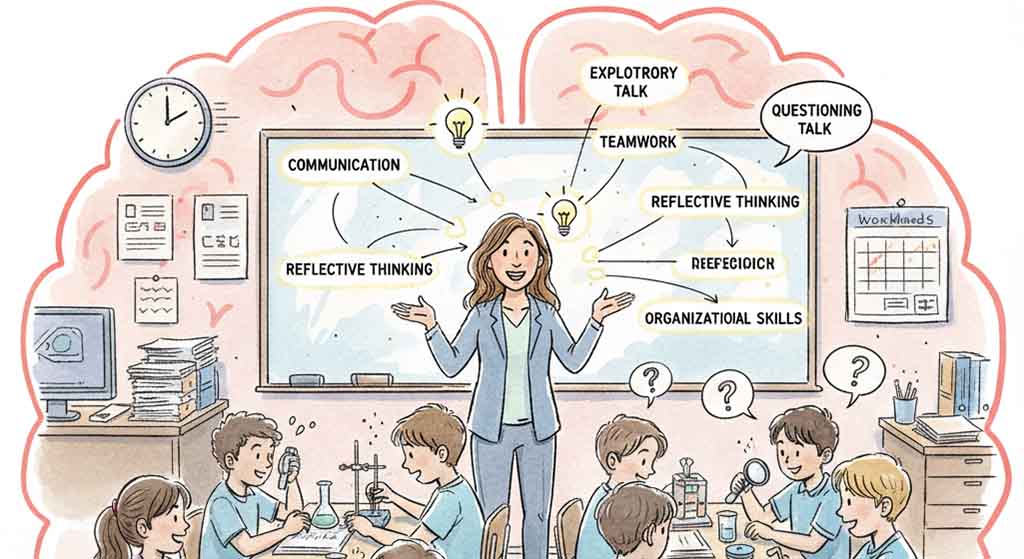
Development of transversal competencies is crucial for employee’s endurance in the 21st century job market. The education system promises the development of these skills. It is vital to explore the classroom talks suitable for the development of transversal competencies at school level. This study aimed at exploring the talk in science classroom and respective developed transversal competencies among 7th grade students (11-12 years age). It was mix-method sequential design to achieve the devised objective. The population was science teachers teaching at grades 6-8 and their students. Ten teachers teaching through interactive talk were purposively selected along with their students (255). The nature of teacher’s talk used in the classroom was marked on the observation sheet during their teaching. Students were assessed of skills, reflective thinking skills, communication skills and teamwork via observation sheet. Both teachers and students were interviewed to explore the underlying reasons certain initiation, student-initiation, response and feedback with some other moves were observed during teaching. While interviewing teachers reported student’s active involvement, in classroom discussions, is enriched source of student’s as well as teacher’s development. However, they highlighted administrative constraints, overcrowded classes, workload of teachers, lack of time and trainings. It is found that exploratory and explanatory talks develop communication skills, responsibility and organizational skills among students. While questioning and involvement in discussions cause reflective thinking, teamwork and communication skills development. It is concluded that interactive class talks are suitable for development of transversal competencies at elementary school level. The students should be engaged in collaborative classroom activities and develop a culture to involve them personally in the process of holistic development.
References
Albert, M. N., & Perouma, J. P. (2017). The dialogue: an essential component to consider “organization as a community of persons”. Humanistic Management Journal, 2(1), 37-55. https://doi.org/10.1007/s41463-017-0024-8
Aldahmash, A. H., Alshalhoub, S. A., & Naji, M. A. (2021). Mathematics teachers’ reflective thinking: Level of understanding and implementation in their professional practices. PLoS One 16(10): e0258149. https://doi.org/10.1371/ journal. pone.0258149.
Alexander, R. J. (2004). Towards Dialogic Teaching: Rethinking classroom talk, 2nd edn. Cambridge: Dialogos.
Almulla, M. A., & Al-Rahmi, W. M. (2023). Integrated social cognitive theory with learning input factors: The effects of problem-solving skills and critical thinking skills on learning performance sustainability. Sustainability, 15(5), 3978. https://doi.org/10.3390/su15053978
Arsenis, P., Flores, M., & Petropoulou, D. (2022). Enhancing graduate employability skills and student engagement through group video assessment. Assessment & Evaluation in Higher Education, 47(2), 245-258. https://doi.org/10.1080/ 02602938.2021.1897086
Barnes, D. (2010). Why talk is important. English Teaching-Practice and Critique, 9(2), 7-10
Behlol, M. G., Akbar, R. A., &Sehrish, H. (2018). Effectiveness of problem solving method in teaching mathematics at elementary level. Bulletin of Education and Research, 40(1), 231-244.
Belchior-Rocha, H., Casquilho-Martins, I., & Simões, E. (2022). Transversal competencies for employability: from higher education to the labour market. Education Sciences, 12(4), 255.https://doi.org/10.3390/educsci12040255
Boso, C. M., Van Der Merwe, A. S., & Gross, J. (2021). Students’ and educators’ experiences with instructional activities towards critical thinking skills acquisition in a nursing school. International Journal of Africa Nursing Sciences, (14). 100293. https://doi.org/10.1016/j.ijans.2021.100293
Budiwati, N. & Yuliyanti, E. (2017).The Use of Problem Solving Method in Increasing Students’ Thinking Ability Analysis. In Proceedings of the 2nd International Conference on Economic Education and Entrepreneurship (ICEEE), pages 492-496 ISBN: 978-989-758-308-7
Care, Vista, & Kim. (2019). https://www.researchgate.net/publication/333700936_ Assessment_of_transversal_competencies_current_tools_in_the_Asian_region
Carvalho, A. (2016). The impact of PBL on transferable skills development in management education. Innovations in Education and Teaching International, 53(1), 35-47
Carver, T. L., & Stickley, A. (2012). “Teamwork in First Year Law Units: Can It Work?” Journal of University Teaching & Learning Practice, 9 (2), 1–33.
Çelik, B. B., & Dikmenli, Y. (2021). Investigating creative and reflective thinking trends of class teacher candidates. Anadolu Kültürel Araştırmalar Dergisi, 5(1), 46-65. https://doi.org/10.15659/anka d.v5i1.101
Chaturvedi, S., Purohit, S., & Verma, M. (2021). Effective teaching practices for success during covid 19 pandemic: towards phygital learning. Front. Educ. 6:646557. doi: 10.3389/feduc.2021.646557
Choy, C. S., & Oo, S. P. (2012). Reflective thinking and teaching practices: a precursor for incorporating critical thinking into the classroom? International Journal of Instruction. 5(1).
Choy, S. C., Yim, J. S. C., & Tan, P. L. (2017). Reflective thinking among preservice teachers: a Malaysian perspective. Issues in Educational Research, 27(2), 234–251.
Clark, A. (2024). Flexible co-construction of meaning: facilitating emergent bi/multilingual children’s emergent exploratory talk in Spanish literature discussions. International Multilingual Research Journal, 18(1), 67-92. https://doi.org/10.1080/19313152.2023.2228563
Creswell, J. W. (2012). Educational research: planning, conducting, and evaluating quantitative and qualitative research. 4th ed. ISBN-13: 978-0-13-136739-5. ISBN-10: 0-13-136739-0.
Dauer, J. M., Lute, M. L., & Straka, O. (2017). Indicators of informal and formal decision-making about a socio scientific issue. International Journal of Education in Mathematics, Science and Technology, 5(2), 124-138.
Donkoh, S., & Amoakwah, A. (2024). The Use and Challenges of Learner-Centered Pedagogy: Basic School Teachers’ Perspective. European Journal of Education and Pedagogy, 5(1), 66-71. https://doi.org/10.24018/ejedu.2024.5.1.774
Dukala, K., Pyrkosz-Pacyna, J., & Czarny, R. (2023). DTMethod: A New Evidence-Based Design Thinking Methodology for Effective Teamwork. Sustainability, 15(5), 4187. https://doi.org/10.3390/su15054187
Ettington, D. R., & Camp, R. R. (2002). Facilitating transfer of skills between group projects and work teams. Journal of Management Education, 26(4), 356-379.
Fisher, E. (1993). Distinctive Features of Pupil-Pupil Classroom Talk and Their Relationship to Learning: How Discursive Exploration Might Be Encouraged. Language and Education, 7(4), 239-257. https://doi.org/10.1080/ 09500789309541363
Fitch, K. (2011). Developing professionals: Student experiences of a real-client project. Higher Education Research & Development, 30(4), 491-503. 10.1080/ 07294360.2010.501074
Goodley, C. (2018). Reflecting on being an effective teacher in an age of measurement. Reflective Practice, 19(2), 167-178. https://doi.org/10.1080/14623943.2018. 1437401
Haavold, P.O., Sriraman, B. (2022) Creativity in problem solving: integrating two different views of insight. ZDM Mathematics Education, 54(2022). https://doi.org/10.1007/s11858-021-01304-8
Hmelo-Silver, C. (2004). Problem-based learning: What and how do students learn? Educational Psychology Review, 16(3), 235–266.
Iqbal, Z., & Mahmood, N. (2020). Patterns of Class Talk Supportive to Prompt Reasoning among Students, Journal of Education & Social Sciences, 8(1), 60-77
Kek, M. Y. C. A., & Huijser, H. (2011). The power of problem‐based learning in developing critical thinking skills: preparing students for tomorrow’s digital futures in today’s classrooms. Higher Education Research & Development, 30(3), 329-341.
Kutbiddinova, A. R., Eromasova, A. A., & Romanova, A. M. (2016). The use of interactive methods in the educational process of the higher education institution. International Journal of Environmental & Science Education, 11(14), 6557-6572. https://www.sciencedirect.com/science/article/pii/S1877129722000648
Kuzle, A. (2015). Problem solving as an instructional method: the use of open problems in technology problem solving instruction. LUMAT, 3(1),
Lee, Y. J. (2020). Dialogical argumentation and reasoning in elementary science classrooms: by Mijung Kim and Wolff-Michael Roth, Leiden, Brill| Sense, 2019, $55 (paperback).
Mandal, S., & Naskar, S. K. (2019). Solving arithmetic mathematical word problems: A review and recent advancements. Information Technology and Applied Mathematics: ICITAM (2017), 95-114.
Mavrikis, M., Rummel, N., Wiedmann, M., Loibl, K., & Holmes, W. (2022). Combining exploratory learning with structured practice educational technologies to foster both conceptual and procedural fractions knowledge. Educational technology research and development, 70(3), 691-712. https://doi.org/10.1007/s11423-022-10104-0
Medvedeva, O. D., & Rubtsova, A. V. (2021). Productive method as the basis for soft skills development in engineering foreign language education. Education Sciences, 11(6), 276. https://doi.org/10.3390/educsci11060276
Melé, D., & González C. (2014). Human foundations of management. New York: Palgrave Macmillan.
Muhonen, H., Verma, P., von Suchodoletz, A., & Rasku-Puttonen, H. (2020). Exploring types of educational classroom talk in early childhood education centres. Research Papers in Education, 37(1), 30–51. https://doi.org/10.1080/ 02671522.2020.1784259
Naughton, M. (2015). Thinking institutionally about business: Seeing its nature as a community of persons and its purpose as the common good. In Humanism in economics and business. 179–199, ed. D. Melé and M. Schlag. Netherlands: Springer.
Nouman, N., Shaikh, Z. A., & Wasi, S. (2024). A novel personalized learning framework with interactive e-mentoring. IEEE Access, 12(24), 10428-10458. doi:10.1109/ ACCESS.2024.3354167
Novak, A. (2024). Exploring Soft Skills Attainment and Workplace Readiness among South Texas Secondary School Students. In Empowering Teachers for Equitable and Sustainable Education (pp. 191-210). Routledge.
OECD (2005).The definition and selection of key competencies. (DeSeCo project) ExecutiveSummary.http://deseco.ch/bfs/deseco/en/index/02.parsys.43469downloadList.2296.DownloadFile.tmp/2005.dskcexecutivesummary.en.pdf
Osipovskaya, E., & Coelho, A. (2024). Comparative analysis of existing frameworks on transversal competences for higher education. In INTED2024 Proceedings (pp. 7518-7524). IATED. https://doi.org/10.21125/inted.2024.1977
Pleschová, G., & McAlpine, L. (2024). What exactly is peer learning? An exploratory analysis of student class interaction. Journal of University Teaching and Learning Practice, 21(07). https://doi.org/10.53761/2y2n6g17
Qizi, K. N. U. (2020). Soft Skills Development in Higher Education. Universal Journal of Educational Research, 8(5). doi: 10.13189/ujer.2020.080528
Saracoglu, M. (2022). Reflective thinking and inquiry skills as predictors of self-efficacy in teaching mathematics. Problems of Education in the 21st Century, 80(1), 213-231.
Shaheen, L. (2024). Role of interactive class talk in development of transversal competencies in grade 7 science students (Unpublished thesis). Department of Science Education. Allama Iqbal Open University Islamabad, Pakistan.
Shaheen, L. C., Mahmood, N., & Iqbal, Z. (2024). Relationship between Student’s Social Interaction and Transversal Competencies at Elementary Level. Educational Research and Innovation, 4(1), 243-259. https://doi.org/10.61866/eri.v4i1.110
Shaheen, L., Mahmood, N., & Iqbal, Z. (2023). Development of Transferable Skills among Grade 7 Students through Discussion Method. UMT Education Review, 6(2), 32-51. https://doi.org/10.32350/uer.62.02
Shamim, F. (2008). Trends, issues and challenges in English language education in Pakistan. Asia Pacific Journal of Education, 28(3), 235-249.
Suparno, Supriyanto, B., & Sudomo. (2018). Applying The Problem-Solving Method to Improve Student Learning Achievement in the Concrete Construction 1 Course. Advances in Social Science, Education and Humanities Research (ASSEHR), (201). https://doi.org/10.2991/aptekindo-18.2018.52
Sutherland, J. (2006). Promoting group talk and higher-Order-thinking in pupils by ‘coaching’ secondary English trainee teachers. Literacy, 40(2), 106-114. https://doi.org/10.1111/j.1467-9345.2006.00436.x
Terzieva, L., Luppi, E., & Traina, I. (2015). Teaching and assessing transferable/ transversal competences. The case of Socces. Journal of Science & Research, (8), 1-22.
Thornhill-Miller, B., Camarda, A., Mercier, M., Burkhardt, J. M., Morisseau, T., Bourgeois-Bougrine, S., ... & Lubart, T. (2023). Creativity, critical thinking, communication, and collaboration: assessment, certification, and promotion of 21st century skills for the future of work and education. Journal of Intelligence, 11(3), 54. https://doi.org/10.3390/jintelligence11030054
T'Sas, J., & Daems, F. (2024). Exploratory talk in times of Globalisation and Digitalisation: a narrative review. L1-Educational Studies in Language and Literature, 24(2), 1-38. https://doi.org/10.21248/l1esll.2024.24.2.609
Vauras, M., Volet, S., & Nolen, S. B. (2019). Supporting motivation in collaborative learning: Challenges in the face of an uncertain future. In Motivation in Education at a time of global change (Vol. 20, pp. 187-203). Emerald Publishing Limited. https://doi.org/10.1108/S0749-742320190000020012
Vardi, I., & Ciccarelli, M. (2008). Overcoming problems in problem based learning: a trial of strategies in an undergraduate unit. Innovations in Education and Teaching International, 45(4), 345–354. https://doi.org/10.1080/ 14703290802377190
Wegerif, R. & Mercer, N. (1997). A dialogical framework for researching peer talk. Language and Education Library, 12, 49-64. ISBN: 1853593915
Zhu, L., Sun, D., Luo, M., Liu, W., & Xue, S. (2024). Investigating pre-service science teachers’ design performance in laboratory class: The inquiry-based design thinking approach. Journal of science education and technology, 33(1), 30-44. https://doi.org/10.1007/s10956-023-10050-3
Downloads
Published
How to Cite
Issue
Section
License
Copyright (c) 2026 Bulletin of Education and Research

This work is licensed under a Creative Commons Attribution-NonCommercial-ShareAlike 4.0 International License.