
Cultivating positive work experiences: Leader-member exchange as a pathway from ebullient supervision to psychological safety and learning motivation
Keywords:
Knowledge sabotage, dispositional greed, Shame, IT sectorAbstract
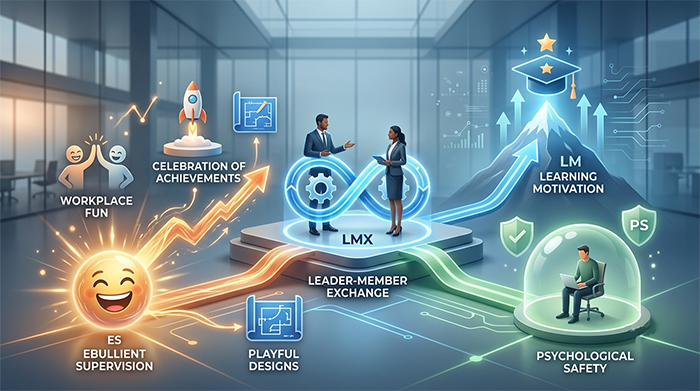
This study intends to investigate the impact of ebullient supervision (ES) on psychological safety (PS) and learning motivation (LM) through the mediating role of leader-member exchange (LMX). Data were collected through a questionnaire from 423 supervisor-subordinate dyads employed in software houses in Pakistan. The findings show that ES, through the implementation of result-oriented workplace fun practices, positively influences the perception of psychological safety and boosts LM. The finding suggests that managers can adopt practices of an ebullient supervisor, such as playful designs, well-planned fun activities, and celebration of achievements, to motivate employees and develop deeper bonds with them.
References
Aboramadan, M., & Kundi, Y. M. (2023). Emotional culture of joy and happiness at work as a facet of wellbeing: a mediation of psychological safety and relational attachment. Personnel Review, 52(9), 2133-2152. https://doi.org/10.1108/PR-04-2021-0285
Ahmad, S., Islam, T., & Kaleem, A. (2025). The power of playful work design in the hospitality industry: mapping the implications for employee engagement, taking charge and the moderation of contrived fun. International Journal of Hospitality Management, 128, 1-12. https://doi.org/10.1016/j.ijhm.2025.104154
Ahmed, N. M., Fayyaz, E., & Hameed, H. (2025). Ebullient Leadership and Employee Happiness in Pakistan's Tourism Sector: The Mediating Role of Employee Advocacy. Academy of Education and Social Sciences Review, 5(2), 274-287. https://doi.org/10.5281/zenodo.15566306
Alajhar, N. A., Bajaba, S., & Basahal, A. (2025). Leading with laughter: the impact of ebullient supervision on commitment to organizational career and employee time theft via psychological distress. The International Journal of Human Resource Management, 36(15), 1-42. https://doi.org/10.1080/09585192.2025.2565655
Alshahrani, M. A., Yaqub, M. Z., Ali, M., El Hakimi, I., & Salam, M. A. (2025). Could entrepreneurial leadership promote employees’ IWB? The roles of intrinsic motivation, creative self-efficacy and firms’ innovation climate. International Journal of Innovation Science. https://doi.org/10.1108/IJIS-08-2024-0211
Bakker, A. B., Caracuzzo, E., Breevaart, K., Urbini, F., & Callea, A. (2025). The Role of Daily Leadership in Promoting Playful Work Design: Enhancing Employee Flourishing and Performance. European Management Journal. https://doi.org/10.1016/j.emj.2025.10.009
Blasco-Giner, C., Battistelli, A., Meneghel, I., & Salanova, M. (2025). Psychological capital, autonomous motivation and innovative behavior: a study aimed at employees in social networks. Psychological Reports, 128(4), 2620-2648. https://doi.org/10.1177/00332941231183614
Blau, P. M. (1964). Exchange and Power in Social Life. Wiley, New York, NY.
Byrne, B. M. (2016). Structural Equation Modelling with AMOS: Basic Concepts, Applications, and Programming (3rd ed.). New York: Routledge.
Carmeli, A., Reiter-Palmon, R., & Ziv, E. (2010). Inclusive leadership and employee involvement in creative tasks in the workplace: The mediating role of psychological safety. Creativity Research Journal, 22(3), 250-260. https://doi.org/10.1080/10400419.2010.504654
Colquitt, J. A., LePine, J. A., & Noe, R. A. (2000). Toward an integrative theory of training motivation: a meta-analytic path analysis of 20 years of research. Journal of applied psychology, 85(5), 678. https://doi.org/10.1037/0021-9010.85.5.678
Deci, E. L., & Ryan, R. M. (2000). The "what" and "why" of goal pursuits: Human needs and the self-determination of behavior. Psychological Inquiry, 11(4), 227–268.
Edmondson, A. C., & Bransby, D. P. (2023). Psychological safety comes of age: Observed themes in an established literature. Annual review of organizational psychology and organizational behavior, 10, 55-78. https://doi.org/10.1146/annurev-orgpsych-120920-055217
Forbes, R. (2022). The Effects of Ebullient Supervision and Leader-Member Exchange on Job Crafting in the United States Aerospace Technical Industry Base (Publication Number 42) Crummer Graduate School of Business]. https://scholarship.rollins.edu/dba_dissertations/42/
Ford, R. C., Guzzo, R., Abbott, J. L., & Bowen, J. T. (2019). Development and validation of a measure of ebullient supervision: the ES scale. Journal of Leadership & Organizational Studies, 26(2), 150-162. https://doi.org/10.1177/1548051818786788
Gierczyk, M., Gromkowska-Melosik, A., Scott, S., & Parker, C. (2024). The snowball sampling strategy in the field of social sciences. Contexts and considerations. Przegląd Badań Edukacyjnych (Educational Studies Review), 43(2), 87-104. https://doi.org/10.12775/PBE.2023.029
Gnankob, R. I., Ansong, A., Gyamfi, B. S., Issau, K., & Okorley, E. N. (2024). Ebullient supervision, employee engagement and employee commitment in a higher education institution: the partial least square approach. International Journal of Work Innovation, 5(4), 347-367. https://doi.org/10.1504/IJWI.2024.142025
Graen, G. B., & Uhl-Bien, M. (1995). Relationship-based approach to leadership: Development of leader-member exchange (LMX) theory of leadership over 25 years: Applying a multi-level multi-domain perspective. The leadership quarterly, 6(2), 219-247. https://doi.org/10.1016/1048-9843(95)90036-5
Gu, Q., Tang, T. L.-P., & Jiang, W. (2024). Does moral leadership enhance employee creativity? Employee identification with the leader and leader-member exchange (LMX) as two mediators: Discovery from China’s emergent market. In Monetary Wisdom (pp. 277-294). Elsevier. https://doi.org/10.1016/B978-0-443-15453-9.00003-6
Harvey, R. J., & Hammer, A. L. (1999). Item response theory. The Counseling Psychologist, 27(3), 353-383. https://doi.org/10.1177/0011000099273004
Hassan, Q., Abid, G., Ali, M., Rehmat, M., & Zafar, R. (2024). Ebullient supervision and employee life satisfaction: a moderated mediation model. The Service Industries Journal, 44(5-6), 412-436. https://doi.org/10.1080/02642069.2021.2019221
Hillberg Jarl, F. (2024). The impact of leadership on the workplace learning of individuals and teams: a literature review and synthesis. The Learning Organization, 31(2), 411–439. https://doi.org/10.1108/TLO-11-2022-0144
Imran, M., Li, J., Bano, S., & Rashid, W. (2025). Impact of democratic leadership on employee innovative behavior with mediating role of psychological safety and creative potential. Sustainability, 17(5), 1879. https://doi.org/10.3390/su17051879
Islam, T., Ahmad, S., & Chaudhary, A. (2024). Connecting the dots: exploring the role of ebullient supervision in fostering knowledge sharing through curiosity and informal learning. International Journal of Manpower, 45(9), 1849–1865. https://doi.org/10.1108/IJM-04-2023-0199
Lee, A. Y.-P., Chang, P.-C., & Chang, H.-Y. (2022). How workplace fun promotes informal learning among team members: a cross-level study of the relationship between workplace fun, team climate, workplace friendship, and informal learning. Employee Relations: The International Journal, 44(4), 870-889. https://doi.org/10.1108/ER-06-2021-0251
Lundqvist, D., Wallo, A., Coetzer, A., & Kock, H. (2023). Leadership and learning at work: a systematic literature review of learning-oriented leadership. Journal of Leadership & Organizational Studies, 30(2), 205-238. https://doi.org/10.1177/15480518221133970
Mashkoor, M., & Muhammad, L. (2024). Does ebullient supervision foster thriving, social and creative employees?–it all starts at the top! European Journal of Training and Development, 48(9), 917–932. https://doi.org/10.1108/EJTD-05-2023-0074
Noe, R. A., & Schmitt, N. (1986). The influence of trainee attitudes on training effectiveness: Test of a model. Personnel psychology, 39(3), 497-523. https://doi.org/10.1111/j.1744-6570.1986.tb00950.x
Podsakoff, P. M., MacKenzie, S. B., & Podsakoff, N. P. (2012). Sources of method bias in social science research and recommendations on how to control it. Annual review of psychology, 63, 539-569. https://doi.org/abs/10.1146/annurev-psych-120710-100452
Shetu, S. H., Khan, A. G., Akter, F., & Begum, S. (2026). Creative Teams Under Ebullient Supervision: Roles of Knowledge Sharing and Creative Self-Efficacy. Business Perspective Review, 8(1), 1-16. https://doi.org/10.38157/bpr.v8i1.736
Song, G., Nabi, M. N., Gazi, M. A. I., Amin, M. B., Senathirajah, A. R. B. S., Rahaman, M. A., & Min, Z. (2025). Participative leadership effects on followers’ radical creativity: the role of psychological safety and collaborative relationship. BMC psychology, 13(1), 604. https://doi.org/10.1186/s40359-025-02950-3
Taheri, M., Motealleh, S., & Younesi, J. (2022). Workplace fun and informal learning: the mediating role of motivation to learn, learning opportunities and management support. Journal of Workplace Learning, 34(3), 229-241. https://doi.org/10.1108/JWL-05-2021-0062
Tews, M. J., Hoefnagels, A., Pons, S., & Beaumont-Perez, F. (2025). Examining the impact of fun in the workplace in hospitality internships. International Hospitality Review. https://doi.org/10.1108/IHR-06-2024-0030
VandeWalle, D. (1997). Development and validation of a work domain goal orientation instrument. Educational and psychological measurement, 57(6), 995-1015. https://doi.org/10.1177/001316449705700600
Vu, G. T. H., Doan, L. K., Nguyen, H. H., Phung, G. T., & Nguyen, D. D. (2025). Relationship between benevolent leadership and innovative work behaviour: a moderation and mediation model of leader–member exchange and employee voice. International Journal of Innovation Science. https://doi.org/10.1108/IJIS-09-2024-0277
Wang, C., Yao, J., & Gao, L. (2024). How do leaders' positive emotions improve employees’ psychological safety in China? The moderating effect of leader-member exchange. Heliyon, 10(3). https://doi.org/https://doi.org/10.1016/j.heliyon.2024.e25481
Zahoor, Q., Sair, S. A., & Sabir, S. A. (2025). From Supervision to Innovation: Exploring the Sequential Pathways of Work-Life Balance and Effort. The Critical Review of Social Sciences Studies, 3(1), 2238-2253. https://doi.org/10.59075/7zvn8a41
Downloads
Published
How to Cite
Issue
Section
License
Copyright (c) 2026 Bulletin of Education and Research

This work is licensed under a Creative Commons Attribution-NonCommercial-ShareAlike 4.0 International License.