
Understanding Knowledge Sabotage among IT employees in Pakistan
DOI:
https://doi.org/10.68490/ber.2026.1.324Keywords:
knowledge sabotage, dispositional greed, ShameAbstract
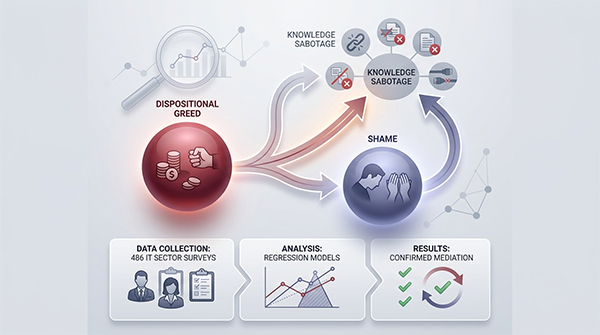
Employees’ involvement in knowledge malpractices have become challenge to today’s organizations. Therefore, this study is an effort to understand what motivates these individuals to engage in knowledge sabotage (KS). Specifically, this study sheds light on dispositional greed (DG) as the main driver of KS to affect emotional consequence shame (SH). The data for this quantitative research is collected from 486 workers of IT sector of Pakistan. The results have confirmed that DG influences KS through SH. The findings also provide insightful information for professionals who are striving to discourage KS at work.
References
Ahmed, E. I. (2025). Principals’ leadership styles and teachers’ organizational citizenship behaviour: A systematic review of research. International Journal of Educational Management, 39(1), 219–239.
Alam, M. A., Calhoun, V., & Wang, Y. P. (2016, October). Influence function of multiple kernel canonical analysis to identify outliers in imaging genetics data. In Proceedings of the 7th ACM International Conference on Bioinformatics, Computational Biology, and Health Informatics (pp. 210–219).
Bello, I., Ahmad, M., & Nadzir, M. M. (2023). Determinants of knowledge transfer for information technology project managers: A systematic literature review. Interdisciplinary Journal of Information, Knowledge, and Management, 18, 871–891.
Binsaeed, R. H., Yousaf, Z., Grigorescu, A., Samoila, A., Chitescu, R. I., & Nassani, A. A. (2023). Knowledge sharing key issue for digital technology and artificial intelligence adoption. Systems, 11(7), 316.
Burhan, Q., Malik, M. F., Siddiqui, M. A., & Khwaja, M. G. (2025). Perceived scarcity on workplace ethics: Greed, social undermining, cutting corner and psychological entitlement. Management Decision. https://doi.org/10.1108/MD-11-2023-2121
Byrne, B. M. (2010). Structural equation modeling with AMOS: Basic concepts, applications, and programming (2nd ed.). Routledge.
Chaudhary, A. (2021). The relationship between affect based trust and employee creativity: The mediating role of knowledge sharing and moderating role of organizational support [Unpublished master’s thesis]. University of the Punjab.
Chen, L., & Zhang, S. (2024). Employees’ unethical pro-organizational behavior and subsequent internal whistle-blowing. Chinese Management Studies, 19(1), 271–285.
Davis, C. G. (2024). Self‐concealment, secrecy, and guilt. Journal of Personality, 92(2), 421–435.
De Clercq, D. (2024). Psychological contract breaches, plans to quit, and destructive voice behavior: Catalytic effects of proactive personality. European Management Journal. https://doi.org/10.1016/j.emj.2024.03.010
Harder, D. W., & Lewis, S. J. (1987). The assessment of shame and guilt. In J. N. Butcher & C. D. Spielberger (Eds.), Advances in personality assessment (pp. 89–114). Lawrence Erlbaum.
Hobfoll, S. E., Halbesleben, J., Neveu, J. P., & Westman, M. (2018). Conservation of resources in the organizational context: The reality of resources and their consequences. Annual Review of Organizational Psychology and Organizational Behavior, 5(1), 103–128.
Islam, T., Chaudhary, A., & Aziz, M. F. (2022). I regret to hide knowledge: A coping strategy model. Global Knowledge, Memory and Communication, 71(4–5), 230–252.
Kholed, S.N.S., Maon, S.N., & Hassan, N.M. (2021). Reliability and validity of the inter-professional collaboration practice instrument. Journal of Interprofessional Education & Practice, 24, https://doi.org/10.1016/j.xjep.2021.100450
Li, M., Xu, X., & Kwan, H.K. (2021). The antecedents and consequences of workplace envy: A meta-analytic review. Asia Pacific Journal of Management. https://doi.org/10.1007/s10490-021-09772-y
Perotti, F. A., Belas, J., Jabeen, F., & Bresciani, S. (2023). The influence of motivations to share knowledge in preventing knowledge sabotage occurrences: An empirically tested motivational model. Technological Forecasting and Social Change, 192, 122571.
Perotti, F. A., Ferraris, A., Candelo, E., & Busso, D. (2022). The dark side of knowledge sharing: Exploring “knowledge sabotage” and its antecedents. Journal of Business Research, 141, 422–432.
Podsakoff, P. M., MacKenzie, S. B., Podsakoff, N. P., & Lee, J. Y. (2003). Common method biases in behavioral research: A critical review of the literature and recommended remedies. Journal of Applied Psychology, 88(5), 879–903.
Sekhar, S., Uppal, N., & Shukla, A. (2020). Dispositional greed and its dark allies: An investigation among prospective managers. Personality and Individual Differences, 162, https://doi.org/10.1016/j.paid.2020.110005
Serenko, A. (2019). Knowledge sabotage as an extreme form of counterproductive knowledge behavior: Conceptualization, typology, and empirical demonstration. Journal of Knowledge Management, 23(7), 1260–1288.
Serenko, A., & Choo, C. W. (2020). Knowledge sabotage as an extreme form of counterproductive knowledge behavior: The role of narcissism, Machiavellianism, psychopathy, and competitiveness. Journal of Knowledge Management, 24(9), 2299–2325.
Seuntjens, T. G., Zeelenberg, M., Van de Ven, N., & Breugelmans, S. M. (2015). Dispositional greed. Journal of Personality and Social Psychology, 108(6), 917–933.
Tabachnick, B. G., & Fidell, L. S. (2007). Using multivariate statistics (5th ed.). Pearson.
Tangney, J. P., & Tracy, J. L. (2012). Self-conscious emotions. In M. R. Leary & J. P. Tangney (Eds.), Handbook of self and identity (2nd ed., pp. 446–478). Guilford Press.
Thomas, A. (2025). The dynamics of knowledge behaviors: Exploring drivers, triggers and paradoxes in knowledge sharing, hiding, hoarding and sabotage. Journal of Knowledge Management, 29(11), 117–144.
Wang, H., & Xie, X. (2023). The bright side of dispositional greed: Empathy for pain. Current Psychology, 42(9), 7012–7019.
Xu, S., Yaacob, Z., & Cao, D. (2024). Casting light on the dark side: Unveiling the dual-edged effect of unethical pro-organizational behavior in ethical climate. Current Psychology, 43(16), 14448–14469.
Zeelenberg, M., & Breugelmans, S. M. (2022). The good, bad and ugly of dispositional greed. Current Opinion in Psychology, 46, https://doi.org/10.1016/j.copsyc.2022.101323
Zeelenberg, M., Evans, A. M., Hoyer, K., & Seuntjens, T. G. (2024). Disentangling greed and self-interest. Discover Psychology, 4(1), 118.
Zhang, J., Jehangir, F. N., Yang, L., Tahir, M. A., & Tabasum, S. (2025). Competitive advantage and firm performance: The role of organizational culture, organizational innovation, and knowledge sharing. Journal of the Knowledge Economy, 16(1), 3081–3107.
Zou, L., Wang, Y., & Liu, C. (2025). Emotional and subsequent behavioral responses after unethical pro-organizational behavior: A meta-analysis based systematic review. Behavioral Sciences, 15(9), 1266.
Downloads
Published
How to Cite
Issue
Section
License
Copyright (c) 2026 Bulletin of Education and Research

This work is licensed under a Creative Commons Attribution-NonCommercial-ShareAlike 4.0 International License.