
Achievement in Mathematics: Effects of Academic Motivation, Mathematics Motivation, and Mathematics Engagement
Keywords:
Academic motivation, mathematics motivation, mathematics engagementAbstract
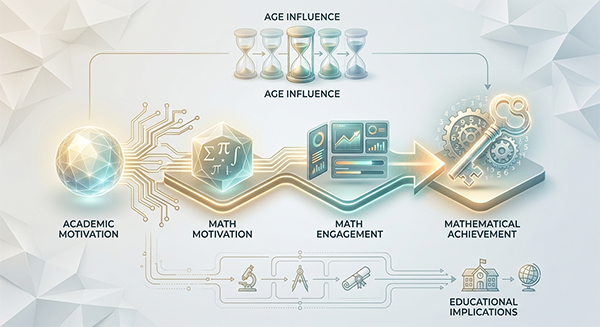
For the current study, a quantitative research design was used to examine the relationships among motivational and engagement factors associated with academic achievement in mathematics among Grade 8 students. The purpose was to determine how students' academic motivation, mathematics motivation, and mathematics engagement relate to each other and to their mathematical achievement. A sample of 30 mathematics teachers was selected from private schools in Karachi to provide data about their students. These teachers provided data about the motivations, engagement, and mathematical performance of 120 students (60 boys and 60 girls) using a structured questionnaire. The study evaluated the direct and indirect relationships between motivational and engagement factors and mathematics achievement using partial least squares structural equation modeling (PLS-SEM). The findings indicate a strong correlation between academic motivation and mathematical performance through the chain mediation effects of math motivation and math engagement. The study also looked at how students' ages influenced the relationship between mathematical achievement and motivational factors, highlighting the need for teachers to pay closer attention to Grade 8 students in order to help them transform from general motivation to mathematics motivation. The results have implications for curriculum interventions that may improve mathematics education in teacher-training institutions as well as for the development of supportive learning environments that promote motivation and engagement in mathematics.
References
Bandura, A. (1997). Self-efficacy: The exercise of control. W. H. Freeman.
Chase, P., Hilliard, L., Geldhof, G., Warren, D., & Lerner, R. (2014). Academic achievement in the high school years: The changing role of school engagement. Journal of Youth and Adolescence, 43, 884–896. https://doi.org/10.1007/s10964-013-0085-4
Choi, H., & Jun, J. (2023). The dual mediating effect of career identity and career decision self-efficacy on the relationship between social support and career maturity perceived by elementary school students. The Institute of Humanities at Soonchunhyang University. https://doi.org/10.35222/ihsu.2023.42.1.147
Elliot, A. J. (2005). A conceptual history of the achievement goal construct. In A. J. Elliot & C. S. Dweck (Eds.), Handbook of competence and motivation (pp. 52–72). The Guilford Press
Finn, J. D., & Zimmer, K. S. (2012). Student engagement: What is it? Why does it matter? Handbook of research on student engagement (pp. 97-131). Springer. http://dx.doi.org/10.1007/978-1-4614-2018-7_5
Fornell, C., & Larcker, D. F. (1981). Structural equation models with unobservable variables and measurement error: Algebra and statistics. Journal of Marketing Research, 18, 382–388. https://doi.org/10.2307/3150980
Fredricks, J. A., Blumenfeld, P. C., & Paris, A. H. (2004). School engagement: Potential of the concept, state of the evidence. Review of Educational Research, 74(1), 59–109. http://dx.doi.org/10.3102/00346543074001059
Green, J., Martin, A., & Marsh, H. W. (2007). Motivation and engagement in high school English, Mathematics and Science high school subjects: Towards an understanding of multidimensional domain specificity. Learning and Individual Differences, 17, 269–279. https://doi.org/10.1016/j.lindif.2006.12.003
Guay, F., Chanal, J., Ratelle, C. F., Marsh, H. W., Larose, S., & Boivin, M. (2010). Intrinsic, identified, and controlled types of motivation for school subjects in young elementary school children. British Journal of Educational Psychology, 80(4), 711–735. https://doi.org/10.1348/000709910X499084
Hair, J.F., Black, W.C., Babin, B.J. & Anderson, R.E. (2010). Multivariate data analysis (7th ed.). Pearson.
Henseler, J., Ringle, C. M., & Sarstedt, M. (2015). A new criterion for assessing discriminant validity in variance-based structural equation modeling. Journal of the Academy of Marketing Science, 43(1), 115–135. https://doi.org/10.1007/s11747-014-0403-8
Koenka, A. (2020). Academic motivation theories revisited: An interactive dialog between motivation scholars on recent contributions, underexplored issues, and future directions. Contemporary Educational Psychology, 61, Article 101831. https://doi.org/10.1016/j.cedpsych.2019.101831
Kumari, A., & Sangwan, S. (2021). Gender differences in academic motivation among elementary school students. The Pharma Innovation Journal, 10(2), 318–321. www.thepharmajournal.com
Leahy, M., & Fitzpatrick, N. (2017). Early Readers and Academic Success. Journal of Educational and Developmental Psychology, 7, 87. https://doi.org/10.5539/JEDP.V7N2P87
Lei, H., Cui, Y., & Zhou, W. (2018). Relationships between student engagement and academic achievement: A meta-analysis. Social Behavior and Personality, 46, 517–528. https://doi.org/10.2224/SBP.7054
McClelland, M., Acock, A., & Morrison, F. (2006). The impact of kindergarten learning-related skills on academic trajectories at the end of elementary school. Early Childhood Research Quarterly, 21, 471–490. https://doi.org/10.1016/J.ECRESQ.2006.09.003
Mendoza, N., & King, R. (2020). The social contagion of student engagement in school. School Psychology International, 41, 454–474. https://doi.org/10.1177/0143034320946803
Moote, J., Archer, L., DeWitt, J., & MacLeod, E. (2020). Science capital or STEM capital? Exploring relationships between science capital and technology, engineering, and maths aspirations and attitudes among young people aged 17/18. Journal of Research in Science Teaching, 57(8), 1228–1249. https://doi.org/10.1002/tea.21628
Newmann, F. M., Wehlage, G. G., & Lamborn, S. D. (1992). The significance and sources of student engagement. In F. M. Newmann (Ed.), Student engagement and achievement in American secondary schools (pp. 11–39). Teachers College Press.
Nunnally, J., & Bernstein, I. (1994). Psychometric theory (3rd ed.). McGraw-Hill.
Piaget, J. (1964). Cognitive development in children: Development and learning. Journal of Research in Science Teaching, 2, 176–186. http://doi.org/10.1002/tea.3660020306
Pintrich, P. R. (2003). A motivational science perspective on the role of student motivation in learning and teaching contexts. Journal of Educational Psychology, 95, 667–686. https://doi.org/10.1037/0022-0663.95.4.667
Rabiner, D., Godwin, J., & Dodge, K. (2016). Predicting academic achievement and attainment: The contribution of early academic skills, attention difficulties, and social competence. School Psychology Review, 45, 250–267. https://doi.org/10.17105/SPR45-2.250-267
Schunk, D. H., Meece, J. I., & Pintrich, P. R. (2014). Motivation in education: Theory, research, and applications. Prentice Hall.
Singh, K., Granville, M., & Dika, S. (2002). Mathematics and science achievement: Effects of motivation, interest, and academic engagement. The journal of educational research, 95(6), 323–332. https://doi.org/10.1080/00220670209596607
Watts, T. (2020). Academic achievement and economic attainment: Reexamining associations between test scores and long-run earnings. AERA Open, 6, Article 2332858420928985. https://doi.org/10.1177/2332858420928985
Wigfield, A., & Wentzel, K. (2007). Introduction to motivation at school: Interventions that work [Special Issue: Promoting motivation at school: Interventions that work]. Educational Psychologist, 42, 191–196.
Downloads
Published
How to Cite
Issue
Section
License
Copyright (c) 2026 Bulletin of Education and Research

This work is licensed under a Creative Commons Attribution-NonCommercial-ShareAlike 4.0 International License.