
Education emergency and out-of-school children: A case study of urban settings in Pakistan
Keywords:
Out-of-school children, urban education, dropout, Socio-Cultural BarriersAbstract
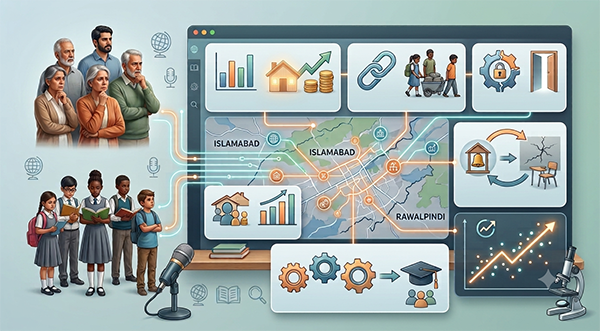
Education is constitutionally guaranteed as a fundamental right in Pakistan under Article 25-A of the Constitution of the Islamic Republic of Pakistan. Despite improvements in enrollment, Pakistan continues to face a significant education emergency, with approximately 26.2 million children out of school. This qualitative case study examines the socioeconomic, institutional, and gender-based barriers contributing to out-of-school children (OOSC) in the urban settings of Islamabad and Rawalpindi. A total of 56 children (34 out-of-school and 22 at risk of dropout) and 26 parents participated. Data were collected using semi-structured interview questionnaires. Content validity of the instruments was established through expert review by three education researchers. A pilot study (n = 8) ensured clarity and cultural appropriateness. Reliability was strengthened through inter-coder agreement (Cohen’s κ = .81), indicating strong consistency in thematic coding. Findings reveal that household poverty, large family size, child labor, inadequate school infrastructure, and negative teacher attitudes significantly influence dropout and non-enrollment. A strong positive correlation (r = .725, p < .05) was observed between household size and the number of OOSC. Parents emphasized financial assistance and teacher training as primary solutions, while children highlighted poor teaching practices and humiliating classroom experiences. The study recommends targeted scholarships, teachers’ professional development, improved infrastructure, and community engagement programs. Limitations include a small sample size, a focus on two districts, and reliance on self-reported data. Further mixed-methods research with larger samples is recommended.
References
Ahmed, Q. W. (2023). Parental involvement in education in rural Pakistan: Children’s, parents’, and teachers’ perspectives (JYU Dissertations 679). University of Jyväskylä.
Ambreen, M., & Mohyuddin, A. (2022). Identifying out of school children in Pakistan: A policy breach. Pakistan Journal of Social Research, 4(1), 1–9. https://doi.org/10.52567/pjsr.v4i01.319
Andrabi, T., Das, J., & Khwaja, A. (2002). The rise of private schooling in Pakistan (Country Study Paper). World Bank.
ASER Pakistan. (2021). Annual status of education report 2021. South Asian Forum for Education Development.
Aslam, M., & Kingdon, G. (2011). What can teachers do to raise pupil achievement? Economics of Education Review, 30(3), 559–574. https://doi.org/10.1016/j.econedurev.2011.01.001
Bano, S., Ahmad, S., & Khan, M. A. (2022). Role of economic and demographic factors on child schooling. Journal of Positive School Psychology, 6(8), 9483–9497.
Becker, G. S. (2009). Human capital: A theoretical and empirical analysis, with special reference to education (3rd ed.). University of Chicago Press.
Behrman, J. R., & Schneider, R. (1993). An international perspective on Pakistani human capital investments in the last quarter century. The Pakistan Development Review, 32(1), 1–68. https://doi.org/10.30541/v32i1pp.1-68
Bronfenbrenner, U. (1979). The ecology of human development: Experiments by nature and design. Harvard University Press.
Choudhry, A. N., Abdul Mutalib, R., & Ismail, N. S. A. (2019). Socio-cultural factors affecting women economic empowerment in Pakistan: A situation analysis. International Journal of Academic Research in Business and Social Sciences, 9(5), 90–102. https://doi.org/10.6007/IJARBSS/v9-i5/5843
Datoo, A. K., Haider, H., & Nawab, A. (2023). Out-of-school children in Northern Sindh, Pakistan: Qualitative exploration of push and pull factors. Academy of Education and Social Sciences Review, 3(1), 11–21. https://doi.org/10.48112/aessr.v3i1.385
Desai, S. (2018). World Development Report 2018: Learning to realize education’s promise. World Bank Group.
Government of Pakistan. (2012). The Constitution of the Islamic Republic of Pakistan. National Assembly of Pakistan. http://www.na.gov.pk/uploads/documents/1333523681_951.pdf
Inter-Agency Commission. (1990). Meeting basic learning needs: A vision for the 1990s. Background document for the World Conference on Education for All. UNESCO. https://unesdoc.unesco.org/ark:/48223/pf0000097552
Khalid, I. (2023). Limited access to education for out-of-school children in Pakistan: Exploring barriers and suggesting measures. Annals of Human and Social Sciences, 4(4), 290–304. https://doi.org/10.35484/ahss.2023(4-IV)26
Kim, S. W., Cho, H., & Kim, L. Y. (2019). Socioeconomic status and academic outcomes in developing countries: A meta-analysis. Review of Educational Research, 89(6), 875–916. https://doi.org/10.3102/0034654319877154
Lloyd, C. B., Mete, C., & Grant, M. J. (2009). The implications of changing educational and family circumstances for children’s grade progression in rural Pakistan: 1997–2004. Economics of Education Review, 28(1), 152–160. https://doi.org/10.1016/j.econedurev.2008.04.002
Lloyd, C. B., Mete, C., & Sathar, Z. A. (2005). The effect of gender differences in primary school access, type, and quality on the decision to enroll in rural Pakistan. Economic Development and Cultural Change, 53(3), 685–710. https://doi.org/10.1086/427211
Mansoor, Z. (2019). Punjab, Pakistan: A case study for using a systems approach for identifying constraints to education service delivery (RISE Working Paper Series 19/032). Research on Improving Systems of Education. https://doi.org/10.35489/BSG-RISE-WP_2019/032
Manzoor, A., Hameed, A., & Nabeel, T. (2016). Voices of out of school children with disabilities in Pakistan. Journal of Research in Special Educational Needs, 16(S1), 1099–1103. https://doi.org/10.1111/1471-3802.12269
McCaul, E. J., Donaldson, G. A., Jr., Coladarci, T., & Davis, W. E. (1992). Consequences of dropping out of school: Findings from high school and beyond. The Journal of Educational Research, 85(4), 198–207. https://doi.org/10.1080/00220671.1992.9941116
Mughal, A. W. (2018). Investigating the issue of out-of-school children in rural Pakistan: Implications for policymakers. Journal of Educational Sciences & Research, 5(2), 53–70.
Omoeva, C., Moussa, W., & Gale, C. (2016). The economic costs of educational inequality in developing countries (EPDC Working Paper No. 16-01). Education Policy and Data Center.
Oreopoulos, P. (2007). Do dropouts drop out too soon? Wealth, health and happiness from compulsory schooling. Journal of Public Economics, 91(11–12), 2213–2229. https://doi.org/10.1016/j.jpubeco.2007.02.002
Pakistan Bureau of Statistics. (2015). Pakistan labour force survey 2013-14. Ministry of Planning, Development & Special Initiatives. http://www.pbs.gov.pk/sites/default/files/Labour%20Force/publications/lfs2013-14/Annual_Report_of_LFS_2013-14_Final.pdf
Pakistan Institute of Education. (2024). Pakistan education statistics 2021–22. Ministry of Federal Education and Professional Training.
Sabates, R., Westbrook, J., Akyeampong, K., & Hunt, F. (2010). School dropout: Patterns, causes, changes and policies (Background Paper for EFA Global Monitoring Report). UNESCO.
Spence, M. (1973). Job market signaling. The Quarterly Journal of Economics, 87(3), 355–374. https://doi.org/10.2307/1882010
Stevens, A., & Gillam, S. (1998). Needs assessment: From theory to practice. BMJ, 316(7142), 1448–1452. https://doi.org/10.1136/bmj.316.7142.1448
Tembon, M., & Fort, L. (Eds.). (2008). Girls’ education in the 21st century: Gender equality, empowerment, and economic growth. World Bank Group. https://doi.org/10.1596/978-0-8213-7474-0
Tusińska, M. (2020). Inequality of opportunity—Gender bias in education in Pakistan. Nierówności Społeczne a Wzrost Gospodarczy, 63, 233–245. https://doi.org/10.15584/nsawg.2020.3.15
Ullah Khan, I., & Khan, A. S. (2023). A brief review of education sector in Pakistan. Data Plus Multidisciplinary International Journal, 1(2), 104–115. https://doi.org/10.62887/dataplus.001.02.0013
UNESCO. (2015). Education for all 2000-2015: Achievements and challenges (Global Monitoring Report). UNESCO Publishing.
UNICEF. (2023). Country office annual report 2023: Pakistan. UNICEF.
Winthrop, R., & Graff, C. (2010). Beyond madrasas: Assessing the links between education and militancy in Pakistan (Center for Universal Education Working Paper No. 2). Brookings Institution.
Downloads
Published
How to Cite
Issue
Section
License
Copyright (c) 2026 Bulletin of Education and Research

This work is licensed under a Creative Commons Attribution-NonCommercial-ShareAlike 4.0 International License.