
Exploring the Relationship Between Servant Leadership and Job Retention of Teachers at the Secondary Level in Punjab
Keywords:
Servant leadership, primary job retention, educational leadershipAbstract
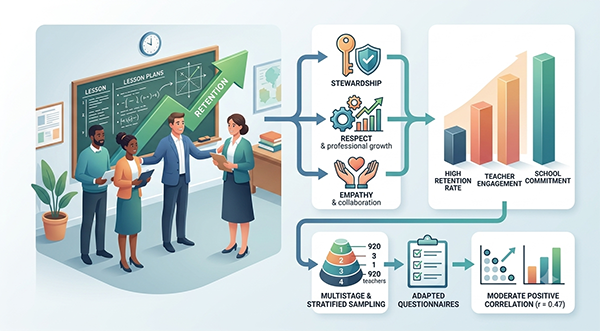
The purpose of the study was to determine the relationship between servant leadership and job retention among Secondary School Teachers. The research was quantitative. The study used a correlational research design. This research employed the use of multistage sampling methods to draw a sample. In each selected district, a stratified random sampling technique was applied in selecting 20 high schools (10 boys and 10 girls) each. Finally, teachers were identified in each of the selected schools. Therefore, the study sample consisted of 920 secondary school teachers (470 male and 450 female). Adapted questionnaires for servant leadership and job retention were used to collect data. Descriptive statistics such as means and standard deviations were utilized to determine the levels of study variables, and Pearson Product-Moment Correlation was used to examine the relationship between servant leadership and job retention. Internal consistency of the instrument was tested using Cronbach's alpha. Reliability scores of instruments were perceived: servant leadership = .763 and job retention = .807. Results of the correlation analysis revealed a moderate, significant, and positive correlation between servant leadership and job retention (r = .47, p < .001). The findings indicate that a teacher's sense of servant leadership behaviors by school leaders is associated with higher retention rates. The study concludes that servant leadership plays an important role in promoting teacher retention in secondary schools. The results indicate a need for administrators and policy makers to promote leadership practices that foster teachers' professional growth, respect, stewardship, and empathy. It is recommended that educational authorities should promote servant leadership by implementing leadership development programs to create positive school environments and to support teachers' retention.
References
Ahmad, S., Batool, A., & Abdullah, N. A. (2023). The perceived servant leadership style of principals correlates with job satisfaction of secondary school teachers in Pakistan. International Journal of Educational Leadership and Management, 11(1), 62–88. https://doi.org/10.17583/ijelm.2023.9169
Arumi, A. M., Johnson, J., & Ott, A. (2006). The insiders: How principals and superintendents see public education today (Reality Check 2006, Issue No. 4). Public Agenda.
Barbuto Jr., J. E., & Wheeler, D. W. (2006). Scale development and construct clarification of servant leadership. Group & Organization Management, 31(3), 300–326. https://doi.org/10.1177/1059601106287091
Barth, R. S. (2006). Improving relationships within the schoolhouse. Educational Leadership, 63(6), 8–13.
Berry, B. (Ed.). (2011). Teaching 2030: What we must do for our students and our public schools: Now and in the future. Teachers College Press.
Black, D. (2010). The behavior of law (Special ed.). Emerald Group Publishing.
Blanchard, K. (2018). Leading at a higher level: Blanchard on leadership and creating high-performing organizations. FT Press.
Blanchard, K., Blanchard, K. H., & Hodges, P. (2008). Lead like Jesus. Thomas Nelson Inc.
Bolman, L. G., & Deal, T. E. (2011). Leading with soul: An uncommon journey of spirit. John Wiley & Sons.
Brumley, C. (2011). Leadership standards in action: The school principal as servant-leader. R & L Education.
Burns, P. (2003). An introduction to tourism and anthropology. Routledge.
Bush, T. (2008). Leadership and management development in education. Sage.
Cochran-Smith, M., Feiman-Nemser, S., McIntyre, D. J., & Demers, K. E. (Eds.). (2008). Handbook of research on teacher education: Enduring questions in changing contexts. Routledge.
Cole, A. (2006). Simplicity for the sophisticated: Rereading the Daode jing for the polemics of ease and innocence. History of Religions, 46(1), 1–49. https://doi.org/10.1086/503414
Covey, S. M. R. (2008). Trust is a competency. Chief Learning Officer, 7(5), 54–56.
Covey, S. M. R. (2008a). The leader in me: How schools and parents around the world are inspiring greatness, one child at a time. Free Press.
Covey, S. R. (2012). The wisdom and teachings of Stephen R. Covey. Simon and Schuster.
Crippen, C. (2005). The democratic school: First to serve, then to lead. Canadian Journal of Educational Administration and Policy, (47), 1–17. https://files.eric.ed.gov/fulltext/EJ846732.pdf
Culver, M. (2013). Applying servant leadership in today's schools. Routledge.
Evans, R. (2010). Seven secrets of the savvy school leader: A guide to surviving and thriving. John Wiley & Sons.
Eva, N., Robin, M., Sendjaya, S., van Dierendonck, D., & Liden, R. C. (2019). Servant leadership: A systematic review and call for future research. The Leadership Quarterly, 30(1), 111–132. https://doi.org/10.1016/j.leaqua.2018.07.004
Ferch, S. R., & Spears, L. C. (Eds.). (2012). The spirit of servant-leadership. Paulist Press.
Frick, D. M., & Sipe, J. W. (2015). Seven pillars of servant leadership: Practicing the wisdom of leading by serving. Paulist Press.
Giacalone, R. A., & Jurkiewicz, C. L. (2010). The science of workplace spirituality. In R. A. Giacalone & C. L. Jurkiewicz (Eds.), Handbook of workplace spirituality and organizational performance (2nd ed., pp. 3–26). M. E. Sharpe.
Greenleaf, R. K. (1970). The servant as leader. The Robert K. Greenleaf Center.
Greenleaf, R. K. (2002). Servant leadership: A journey into the nature of legitimate power and greatness. Paulist Press.
Glazer, J. (2018). Learning from those who no longer teach: Viewing teacher attrition through a resistance lens. Teaching and Teacher Education, 74, 62–71. https://doi.org/10.1016/j.tate.2018.04.011
Goldberg, P. E., & Proctor, K. M. (2000). Teacher voices 2000: A survey on teacher recruitment and retention. Scholastic & Council of Chief State School Officers.
Guarino, C. M., Santibanez, L., & Daley, G. A. (2006). Teacher recruitment and retention: A review of the recent empirical literature. Review of Educational Research, 76(2), 173-208.
Hoxha, L., & Hyseni-Duraku, Z. (2017). The relationship between educational leadership and teachers’ self-efficacy. The European Journal of Social & Behavioural Sciences, 20(3), 261–273. https://doi.org/10.15405/ejsbs.221
Jaiswal, N. K., & Dhar, R. L. (2017). The influence of servant leadership, trust in leader and thriving on employee creativity. Leadership & Organization Development Journal, 38(1), 2–21. https://doi.org/10.1108/LODJ-02-2015-0017
Kouzes, J. M., & Posner, B. Z. (2017). A coach's guide to developing exemplary leaders: Making the most of the leadership challenge and the leadership practices inventory (LPI). John Wiley & Sons.
Latham, A. S. (1998). Teacher satisfaction. Educational Leadership, 55(5), 82–83.
Laub, J. A. (1999). Assessing the servant organization: Development of the Servant Organizational Leadership Assessment (SOLA) instrument (Publication No. 9921922) [Doctoral dissertation, Florida Atlantic University]. ProQuest Dissertations & Theses Global.
Lian, S. L., & Kiang, S. K. S. (2011). Developing servant leaders in secondary schools for leadership positions in the workforce. Paper presented at the Servant Leadership Research Roundtable, School of Global Leadership & Entrepreneurship, Regent University, Virginia Beach, VA, United States. Retrieved from http://hkage.org.hk/en/index.html
Locander, W. B., & Luechauer, D. L. (2006). Trading places: How do you practice servant leadership in an exchange-driven world? Marketing Management, 15(3), 43–45.
Maxwell, S. M. (2015). An exploration of human resource personnel and toxic leadership (Publication No. 3701826) [Doctoral dissertation, Walden University]. Walden University ScholarWorks. https://scholarworks.waldenu.edu/dissertations/548
Mitchell, T. R., Holtom, B. C., Lee, T. W., Sablynski, C. J., & Erez, M. (2001). Why people stay: Using job embeddedness to predict voluntary turnover. Academy of Management Journal, 44(6), 1102–1121. https://doi.org/10.2307/3069391
Millard, B., & Christman, R. (2006, August). The leadership dilemma for evangelicals: McGregor’s theory Y vs. the doctrine of the original depravity of humanity [Conference presentation]. Servant Leadership Research Roundtable, Regent University, Virginia Beach, VA, United States. https://www.regent.edu/acad/sls/publications/conference_proceedings/servant_leadership_roundtable/2006/pdf/millard_christman.pdf
Moore, B. M. (1987, April 20–24). Individual differences and satisfaction with teaching [Paper presentation]. Annual Meeting of the American Educational Research Association, Washington, DC. ERIC Document Reproduction Service No. ED282851.
Mulkeen, A. (2007). Recruiting, retaining, and retraining secondary school teachers and principals in Sub-Saharan Africa (World Bank Working Paper No. 99). The World Bank. https://doi.org/10.1596/978-0-8213-7066-7
Neuschel, R. P. (2005). The servant leader: Unleashing the power of your people. Northwestern University Press.
Organisation for Economic Co-operation and Development. (2005). Improving financial literacy: Analysis of issues and policies. OECD Publishing.
Patterson, K. A. (2003). Servant leadership: A theoretical model (Doctoral dissertation, Regent University).
Piele, P. K., & Smith, S. C. (Eds.). (2006). School leadership: Handbook for excellence in student learning. Corwin Press.
Prosser, J. (2007). Visual methods and the visual culture of schools. Visual Studies, 22(1), 13–30. https://doi.org/10.1080/14725860601167143
Russell, R. F., & Stone, A. G. (2002). A review of servant leadership attributes: Developing a practical model. Leadership & Organization Development Journal, 23(3), 145–157. https://doi.org/10.1108/01437730210424
Saha, L. J., & Dworkin, A. G. (Eds.). (2009). International handbook of research on teachers and teaching (Vol. 21). Springer.
Sendjaya, S., Sarros, J. C., & Santora, J. C. (2008). Defining and measuring servant leadership behaviour in organizations. Journal of Management Studies, 45(2), 402–424. https://doi.org/10.1111/j.1467-6486.2007.00761.x
Sergiovanni, T. J. (2007). An epistemological problem. In T. J. Sergiovanni (Ed.), Out-of-the-box leadership (pp. 49–66). Jossey-Bass.
Spears, L. C. (1996). Reflections on Robert K. Greenleaf and servant leadership. Leadership & Organization Development Journal, 17(7), 33–35. https://doi.org/10.1108/01437739610148367
Spears, L. R. (2012). Social presence, social interaction, collaborative learning, and satisfaction in online and face-to-face courses (Doctoral dissertation, Iowa State University). Iowa State University Digital Repository. https://dr.lib.iastate.edu/items/09b448dd-5f9f-432d-a07d-4e51cb6a79f
Stockard, J., & Lehman, M. B. (2004). Influences on the satisfaction and retention of first-year teachers: The importance of effective school management. Educational Administration Quarterly, 40(5), 742–771. https://doi.org/10.1177/0013161X04268844
Tey, B. (2006). Dare to be a servant-leader: An interview with Larry Spears. The International Journal of Servant-Leadership, 2(1), 45–54.
Taylor, I. M., & Ntoumanis, N. (2007). Teacher motivational strategies and student self-determination in physical education. Journal of Educational Psychology, 99(4), 747–760. https://doi.org/10.1037/0022-0663.99.4.747
UNESCO Institute for Statistics. (2006). Teachers and educational quality: Monitoring global needs for 2015 (UIS Information Bulletin No. 253). UNESCO Institute for Statistics.
Van Dierendonck, D. (2011). Servant leadership: A review and synthesis. Journal of Management, 37(4), 1228–1261. https://doi.org/10.1177/0149206310380462
Wong, P. T. P., Davey, D., & Church, F. B. (2007). Best practices in servant leadership. In Proceedings of the Servant Leadership Research Roundtable (School of Global Leadership & Entrepreneurship, Regent University, Virginia Beach, VA).
Yukl, G. (2009). Leading organizational learning: Reflections on theory and research. The Leadership Quarterly, 20(1), 49–53. https://doi.org/10.1016/j.leaqua.2008.11.006
Young-Ritchie, C., Laschinger, H. S., & Wong, C. (2009). The effects of emotionally intelligent leadership behaviour on emergency staff nurses’ workplace empowerment and organizational commitment. Nursing Leadership, 22(1), 70–85.
Downloads
Published
How to Cite
Issue
Section
License
Copyright (c) 2026 Bulletin of Education and Research

This work is licensed under a Creative Commons Attribution-NonCommercial-ShareAlike 4.0 International License.