Inclusive Education in Pakistan: Practices and Challenges
Keywords:
Inclusive education, teacher perspectives, implementation challenges, infrastructure, primary schoolsAbstract
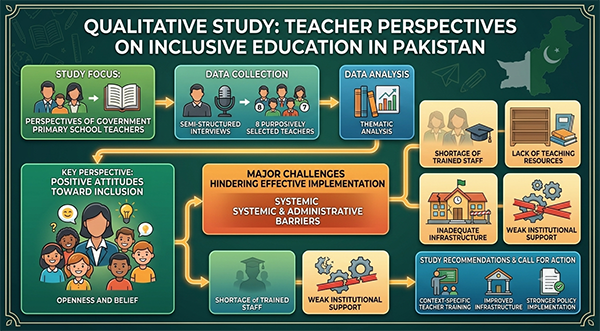
Inclusive education is designed to provide equitable access to quality education for children with disabilities in mainstream schools. While it is acknowledged as a policy priority in Pakistan, its implementation has shown variability across different districts. This qualitative study explores the perspectives of teachers regarding the practices and challenges of inclusive education in primary schools in Pakistan. Data were collected via semi-structured interviews with eight purposively selected teachers from four government primary schools across four districts. Thematic analysis revealed persistent challenges, including a lack of teaching resources, inadequate infrastructure, a shortage of trained staff, and weak institutional support. Although teachers displayed positive attitudes toward inclusive education, systemic and administrative barriers hindered its effective implementation. The study calls for context-specific teacher training, better infrastructure, and stronger policy implementation to support inclusive education in Pakistan.
References
Farooq, M. S. (2012). Problems faced by students with special needs in ordinary Pakistani schools. Journal of Quality and Technology Management, 8(1), 13-27.
Hart, S., Drummond, M., & McIntyre, D. (2007). Learning without limits: constructing a pedagogy free from determinist beliefs about ability. In L. Florian (Ed.) Learning without limits: Constructing a pedagogy free from determinist beliefs about ability (pp. 500-515). SAGE Publications Ltd. https://doi.org/10.4135/9781848607989.n39
Ingstad, B. (2001). Disability in the developing world. In G. L. Albrecht, K. D. Seelman, & M. Bury (Eds.), Handbook of disability studies (pp. 772–792). Sage Publications.
Iqbal, M. Z., Khan, S., & Zia Ullah, M. (2016). Gaps and hindrances in launching inclusive education in Pakistan. Educational Research International, 5(1), 20–28.
Koretz, D., & Hamilton, L. (2000). Assessment of students with disabilities in Kentucky: Inclusion, student performance, and validity. Educational Evaluation and Policy Analysis, 22(3), 255–272. https://doi.org/10.3102/01623737022003255
Nind, M. (2016). Inclusive research as a site for lifelong learning: Participation in learning communities. Studies in the Education of Adults, 48(1), 23-37. https://doi.org/10.1080/02660830.2016.1155847
Pasha, S. (2012). Readiness of urban primary schools for inclusive education in Pakistan. Journal of Research and Reflections in Education, 6(2), 113-128.
Seda, C. H., & Walton, E. (2025). Teacher education for inclusive education: A scoping review of Global South scholarship. Journal of Education for Teaching. Advance online publication. https://doi.org/10.1080/02607476.2025.2520792
United Nations Economic and Social Commission for Asia and the Pacific. (2001). Pathfinders: Towards full participation and equality of persons with disabilities in the ESCAP region. United Nations.
UNESCO. (2001). Inclusive schools and community support programmes: Report 1998. https://unesdoc.unesco.org/ark:/48223/pf0000117625
Downloads
Published
How to Cite
Issue
Section
License
Copyright (c) 2026 Bulletin of Education and Research

This work is licensed under a Creative Commons Attribution-NonCommercial-ShareAlike 4.0 International License.