
A Study of Relationship Between Self-Esteem and Optimism in Secondary School Teachers of Lahore
Keywords:
Self-esteem, optimism, teacher well-being, psychological strengths, secondary education, secondary school teachersAbstract
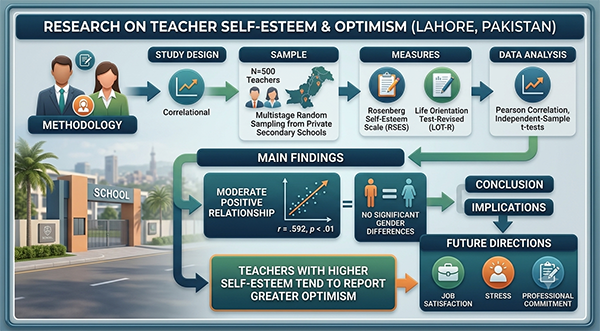
This study examined the relationship between self-esteem and optimism among secondary school teachers in Lahore, Pakistan. Using a correlational research design, a multistage random sample of 500 teachers (250 male, 250 female) from private secondary schools completed the Rosenberg Self-Esteem Scale (RSES) and the Life Orientation Test-Revised (LOT-R) to measure self-esteem and optimism. Data were analyzed using Pearson product-moment correlation and independent-sample t-tests. Results revealed a moderate positive relationship between self-esteem and optimism (r = .592, p < .01). No significant gender differences were found in self-esteem or optimism. Findings suggest that teachers with higher self-esteem tend to report greater optimism, highlighting the potential value of teacher well-being interventions. Future research could explore how optimism and self-esteem influence job satisfaction, stress, and professional commitment.
References
Afzal, M., Waqas, A., Farooq, A., & Hussain, M. (2016). The impact of transformational leadership style on nurses’ self-esteem in public hospitals of Lahore, Pakistan. International Journal of Social Sciences and Management, 3(4), 287–293. https://doi.org/10.3126/ijssm.v3i4.15963
Ahmad, M., Majeed, S., & Ullah, S. (2023). Academic optimism: A study of secondary school teachers’ perceptions. Journal of Development and Social Sciences, 4(2), 16–28. https://doi.org/10.47205/jdss.2023(4-II)02
Anwar, M., & Nasreen, S. (2024). Interrelationship of teacher self-esteem in private secondary schools of Lahore. Annals of Human and Social Sciences, 5(2), 596–609. https://doi.org/10.35484/ahss.2024(5-II)55
Bibi, Z., & Karim, J. (2017). Self-esteem, resilience, and social trust as mediators in the relationship between optimism and job satisfaction: A preliminary analysis. Pakistan Journal of Psychological Research, 32(1), 155–173.
Borralho, L., Araújo Candeias, A., de Jesus, S. N., & Viseu, J. (2025). Healthy school, healthy teachers: Mediating effect of optimism. Frontiers in Psychology, 16, 1506161. https://doi.org/10.3389/fpsyg.2025.1506161
Brodhagen, A., & Wise, D. (2008). Optimism as a mediator between the experience of child abuse, other traumatic events, and distress. Journal of Family Violence, 23(6), 403–411. https://doi.org/10.1007/s10896-008-9165-8
Carver, C. S., & Scheier, M. F. (2014). Dispositional optimism. Trends in Cognitive Sciences, 18(6), 293–299. https://doi.org/10.1016/j.tics.2014.02.003
Chohan, B. I., & Qadir, S. A. (2013). Self-esteem of the repeaters: A mixed-method study of elementary grade students. Pakistan Journal of Psychological Research, 28(2).
Gay, L. R., Mills, G. E., & Airasian, P. W. (2012). Educational research: Competencies for analysis and applications (10th ed.). Pearson.
George, D., & Mallery, P. (2019). IBM SPSS statistics 26 step by step: A simple guide and reference. Routledge.
Greenberg, J. (2008). Understanding the vital human quest for self-esteem. Perspectives on Psychological Science, 3(1), 48–55. https://doi.org/10.1111/j.1745-6916.2008.00061.x
Greenberg, J., Pyszczynski, T., & Solomon, S. (1986). The causes and consequences of a need for self-esteem: A terror management theory. In R. F. Baumeister (Ed.), Public self and private self (pp. 189–212). Springer. https://doi.org/10.1007/978-1-4613-9564-5_10
Jenaabadi, H., Ahani, M. A., & Sabaghi, F. (2015). Examining the relationship of optimism and emotion regulation strategies with general health among students of University of Sistan and Baluchestan. Health, 7(7), 865–872. https://doi.org/10.4236/health.2015.77102
Kamran, F., & Schaw, C. F. (2017). Perceived health status and life orientation (optimism) after renal transplantation. Pakistan Journal of Psychological Research, 32(1).
Li, J. (2024). Work–family conflict, optimism, and job satisfaction among teachers in Chinese private middle schools. Advances in Social Behavior Research, 10, 49–53. https://doi.org/10.54254/2753-7102/10/2024093
Malik, M. E., Naeem, B., & Ahmad, W. (2013). Role of optimism subculture and optimism in sales force creative performance: Empirical evidence from pharmaceutical industry in Pakistan. World Applied Sciences Journal, 24(8), 1037–1043.
Maslow, A. H. (1987). Motivation and personality (3rd ed.). Harper & Row.
Newark, P. E., Elsässer, M., & Stieglitz, R. D. (2016). Self-Esteem, Self-Efficacy, and Resources in Adults With ADHD. Journal of Attention Disorders, 20(3), 279–290. https://doi.org/10.1177/1087054712459561
Roomi, M. A., Farooq, A., Bilal, A., Khaliq, S., Iqbal, H., & Ashraf, M. I. (2022). Self-esteem, optimism, and their associated factors among optometry students at the University of Lahore. Journal of University Medical & Dental College, 13(4), 473–477. https://doi.org/10.37723/jumdc.v13i4.736
Pritchard, M. E., Wilson, G. S., & Yamnitz, B. (2007). What predicts adjustment among college students? A longitudinal panel study. Journal of American College Health, 56(1), 15–21. https://doi.org/10.3200/JACH.56.1.15-22
Puskar, K. R., Bernardo, L. M., Ren, D., Haley, T. M., Hetager Tark, K., Switala, J., & Siemon, L. (2010). Self-esteem and optimism in rural youth: Gender differences. Contemporary Nurse, 34(2), 190–198. https://doi.org/10.5172/conu.2010.34.2.190
Rosenberg, M. (1965). Society and the adolescent self-image. Princeton University Press.
Scheier, M. F., & Carver, C. S. (1985). Optimism, coping, and health: Assessment and implications of generalized outcome expectancies. Health Psychology, 4(3), 219–247. https://doi.org/10.1037/0278-6133.4.3.219
Scheier, M. F., Carver, C. S., & Bridges, M. W. (1994). Distinguishing optimism from neuroticism (and trait anxiety, self-mastery, and self-esteem): A reevaluation of the Life Orientation Test. Journal of Personality and Social Psychology, 67(6), 1063–1078. https://doi.org/10.1037/0022-3514.67.6.1063
Seligman, M. E. P. (2011). Flourish: A visionary new understanding of happiness and well-being. Free Press.
Shaheen, N., Andleeb, S., Ahmad, S., & Bano, A. (2014). Effect of optimism on psychological stress in breast cancer women. FWU Journal of Social Sciences, 8(1), 84–90.
Singh, I., & Jha, A. (2013). Anxiety, optimism and academic achievement among students of private medical and engineering colleges: A comparative study. Journal of Educational and Developmental Psychology, 3(1), 222. https://doi.org/10.5539/jedp.v3n1p222
Woolfolk, A., & Shaughnessy, M. F. (2004). An interview with Anita Woolfolk: The educational psychology of teacher efficacy. Educational Psychology Review, 16(2), 153–176. https://www.jstor.org/stable/23363838
Downloads
Published
How to Cite
Issue
Section
License
Copyright (c) 2026 Bulletin of Education and Research

This work is licensed under a Creative Commons Attribution-NonCommercial-ShareAlike 4.0 International License.