Microaggressions in Multicultural Primary Classrooms: Educators' Perspectives in a Pakistani Metropolis
DOI:
https://doi.org/10.68490/ber.2026.1.340Keywords:
Microaggressions, Early childhood education, Multiculturalism, Critical Race Theory, Implicit biasesAbstract
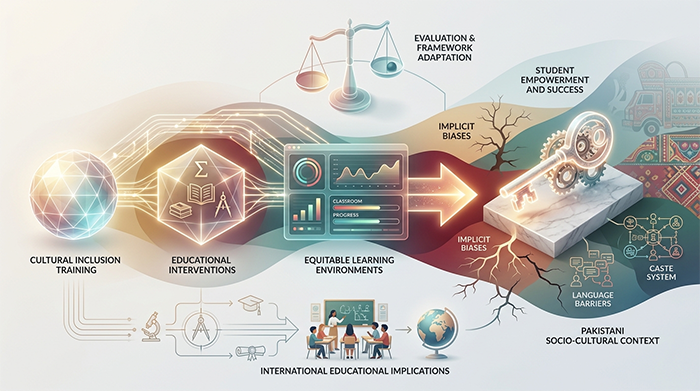
The purpose of the study was to explore and understand microaggression practices in early childhood education in the context of Pakistan, where multiculturalism is more dominant than racism. The study had two objectives: 1) to explore the existence of microaggressions practiced by early childhood teachers in multicultural classrooms, and 2) to examine the views of early childhood teachers and leaders regarding microaggressions when dealing with a multicultural student population. To achieve these objectives, a qualitative phenomenological research methodology was adopted. Ten early childhood institutions approved by the government operating under the federal directorate of education in Islamabad were purposively selected. Qualitative data was collected through observations, semi-structured interviews, and focus group discussions, which were then analyzed thematically using NVivo software. The analytical findings concluded that teachers were intentionally and/or unintentionally practicing microaggressions in their multicultural classrooms. These microaggressions can be classified as microinsults and microinvalidation. It was found that teachers and leaders lacked knowledge and awareness about microaggressions, but there were still implicit biases and prejudices that caused microaggressions unintentionally. These implicit biases were based on preconceived notions of conventional mindset, societal norms, power balance, and caste systems. Even well-qualified teachers at the educational institutions were causing microaggressions intentionally and unintentionally. Microaggressions need to be reduced for a safe learning environment and equal opportunities at early grade levels. Society especially teachers may be made aware and sensitized to understand and address microaggressions in compliance with international educational standards and regulations.
References
Barber, S., Gronholm, P. C., Ahuja, S., Rüsch, N., & Thornicroft, G. (2019). Microaggressions towards people affected by mental health problems: A scoping review. Epidemiology and Psychiatric Sciences, 29, e6. https://doi.org/10.1017/S2045796019000763
Carone, N., Innocenzi, E., & Lingiardi, V. (2022). Peer microaggressions and social skills among school-age children of sexual minority parents through assisted reproduction: Moderation via the child–teacher relationship. Journal of Youth and Adolescence, 51(6), 1210–1229. https://doi.org/10.1007/s10964-022-01588-3
Choi, Y. (2003). The name jar. Dragonfly Books.
Collis, J., & Hussey, R. (2013). Business research: A practical guide for undergraduate and postgraduate students (4th ed.). Palgrave Macmillan.
Ewert, M. (2008). 10,000 dresses. Triangle Square.
Fortunato, J. A., Gigliotti, R. A., & Ruben, B. D. (2018). Analysing the dynamics of crisis leadership in higher education: A study of racial incidents at the University of Missouri. Journal of Contingencies and Crisis Management, 26(4), 510–518. https://doi.org/10.1111/1468-5973.12220
Gayle, B. M., Cortez, D., & Preiss, R. (2013). Safe spaces, difficult dialogues, and critical thinking. International Journal for the Scholarship of Teaching and Learning, 7(2), Article 5. https://doi.org/10.20429/ijsotl.2013.070205
Genhart, M. (2015). Ouch moments: When words are used in hurtful ways. Magination Press.
Gunawan, R. (2017). The role of character education for early children in early childhood education programs in Happy Kids Bogor Indonesia. Advances in Social Science, Education and Humanities Research, 66, 12–15. https://doi.org/10.2991/yicemap-17.2017.5
Harrison, C., & Tanner, K. D. (2018). Language matters: Considering microaggressions in science. CBE—Life Sciences Education, 17(1), fe4. https://doi.org/10.1187/cbe.18-01-0011
Lehmann-Grube, S. K., Tobisch, A., & Dresel, M. (2023). Changing preservice teacher students’ stereotypes and attitudes and reducing judgment biases concerning students of different family backgrounds: Effects of a short intervention. Social Psychology of Education. Advance online publication. https://doi.org/10.1007/s11218-023-09862-3
Miller, S. (2018). Don’t touch my hair! Little, Brown Books for Young Readers.
Morrison, N., Zaman, T., Webster, G., Sorinola, O., & Blackburn, C. (2023). “Where are you really from?”: A qualitative study of racial microaggressions and the impact on medical students in the UK. BMJ Open, 13(5), e069009. https://doi.org/10.1136/bmjopen-2022-069009
Steketee, A., Williams, M. T., Valencia, B. T., Printz, D., & Hooper, L. M. (2021). Racial and language microaggressions in the school ecology. Perspectives on Psychological Science, 16(5), 1075–1098. https://doi.org/10.1177/1745691621995740
Sue, D. W. (2010). Microaggressions in everyday life: Race, gender, and sexual orientation. John Wiley & Sons.
Sue, D. W., Capodilupo, C. M., & Holder, A. (2008). Racial microaggressions in the life experience of Black Americans. Professional Psychology: Research and Practice, 39(3), 329–336. https://doi.org/10.1037/0735-7028.39.3.329
Sue, D. W., Bucceri, J., Lin, A. I., Nadal, K. L., & Torino, G. C. (2007). Racial microaggressions and the Asian American experience. Cultural Diversity and Ethnic Minority Psychology, 13(1), 72–81. https://doi.org/10.1037/1099-9809.13.1.72
Sue, D. W., Capodilupo, C. M., Torino, G. C., Bucceri, J., Holder, A. M. B., Nadal, K. L., & Esquilin, M. (2007). Racial microaggressions in everyday life: Implications for clinical practice. American Psychologist, 62(4), 271–286. https://doi.org/10.1037/0003-066X.62.4.271
Watanabe, T., & Song, J. (2015, November 12). College students confront subtler forms of bias; slights and snubs. Los Angeles Times. http://www.latimes.com/local/education/la-me-college-microaggression-20151112-story.html
Downloads
Published
How to Cite
Issue
Section
License
Copyright (c) 2026 Bulletin of Education and Research

This work is licensed under a Creative Commons Attribution-NonCommercial-ShareAlike 4.0 International License.