
Comparative Effectiveness of Concrete and Virtual Manipulatives on Students’ Learning of LCM and HCF and Classroom Engagement
DOI:
https://doi.org/10.68490/ber.2026.1.333Keywords:
classroom engagement, concrete manipulatives, HCF & LCM, mathematical achievement, virtual manipulativesAbstract
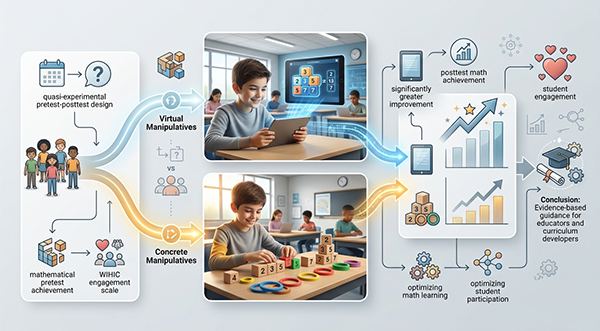
This study looks at how students react to two different types of classroom tools. These tools are called manipulatives. They are designed to help elementary students understand concepts in math that are complex. This study focuses on students' engagement, and achievements in solving prime factorization, least common multiple (LCM), and highest common factor (HCF). The study was conducted in a 2-week period, with 5th grade students. This study used a quasi-experimental approach. The research design used was a pre-test post-test control group. Data was retrieved using pre and posttests in math, and using a scale to measure classroom behaviors. The data were analyzed using one way ANCOVA and two way ANOVA. The data indicates that both types of manipulatives enhanced students' math skills and engagement in class, with students using virtual tools benefiting more. This study can help teachers and those in charge of the curriculum make better teaching plans that help students achieve more in math and participate more in class.
References
Adesokan, R. T. (2024). Rejuvenating the teaching of primary mathematics through the use of manipulatives. Sapientia Foundation Journal of Education, Science and Gender Studies, 6(2), 1-7. http://sfjesgs.com/index.php/SFJESGS/article/view/535/534
Ahmad, S., & Siller, H-S. (2024). Investigating the effect of manipulatives on mathematics achievement: The role of concrete and virtual manipulatives for diverse achievement level groups. Journal on Mathematics Education, 15(3), 979-1002. http://doi.org/10.22342/jme.v15i3.pp979-1002
Bornaa, C. S., Okwan, B., Iddrisu, A. B. et al. (2023). Cooperative learning with manipulatives and students’ performance in mathematics problem solving. Journal of Education and Practice, 14(19), 1-12. https://doi.org/10.7176/JEP/14-19-01
Brau, B. (2020). Constructivism. In R. Kimmons, & S. Caskurli (Eds.), The students’ guide to learning design and research (pp. 33-43). https://doi.org/10.59668/10
Bush, J. B. (2021). Software-based intervention with digital manipulatives to support student conceptual understandings of fractions. British Journal of Educational Technology, 52(6), 2299-2318. https://doi.org/10.1111/bjet.13139
Byrne, E. M., Jensen, H., Thomsen, B. S., & Ramchandani, P. G. (2023). Educational interventions involving physical manipulatives for improving children’s learning and development: A scoping review. Review of Education, 11(2), e3400. https://doi.org/10.1002/rev3.3400
Calibugan, I. C., & Maghuyop, A. Z. (2024). Development of manipulatives in teaching english oral language for grade one. Ignatian International Journal for Multidisciplinary Research, 2(5), 501–516. https://doi.org/10.5281/zenodo.11126536
Carbonneau, K. J., Marley, S. C., & Selig, J. P. (2013). A meta-analysis of the efficacy of teaching mathematics with concrete manipulatives. Journal of Educational Psychology, 105(2), 380–400. https://doi.org/10.1037/a0031084
Clements, D. H., & Sarama, J. (2014). Learning and teaching early math: The learning trajectories approach (2nd ed.). Routledge.
Cohen, L., Manion, L., & Morrison, K. (2017). Research methods in education. London: Routledge. https://doi.org/10.4324/9781315456539
Denhere, C., Chinyoka, K., & Mambeu, J. (2013). Vygotsky's zone of proximal development theory: What are its implications for mathematical teaching? Greener Journal of Social Sciences, 3, 371-377. https://doi.org/10.15580/GJSS.2013.7.052213632
Enuma O. P., & Ijeh, S. B. (2024). Effects of concrete manipulatives and lecture approaches on mathematics students’ academic achievement in Delta North Senatorial District. International Journal of Education and Evaluation (IJEE), 10(2), 161-172. https://doi.org/10.56201/ijssmr.v8.no1.2022.pg32.40
Farra, N. K. A., Belbase, S., Tairab, H., Qablan, A., Opoku, M. P., & Safi, S. K. (2024). Impact of using virtual and concrete manipulatives on students’ learning of fractions. Cogent Education, 11(1). https://doi.org/10.1080/2331186X.2024.2379712
Fauzan, A., Yerizon, Y., & Yulianti, D. (2020). The RME-based local instructional theory for teaching LCM and GCF in primary school. Journal of Physics: Conference Series 1554(1), Article 012078. https://doi.org/10.1088/1742-6596/1554/1/012078
Fisher, L. (2023). Visual math: How virtual manipulatives take learning further. Clarity Innovations. https://www.clarity-innovations.com/blog/visual-math-how-virtual- manipulatives-take-learning-further
Flevares, L. M., Perry, M., Beilstein, S. O. et al. (2022). Examining first-graders’ developing understanding of place value via base-ten virtual manipulatives. Early Childhood Education Journal 50, 359–370. https://doi.org/10.1007/s10643-021-01162-9
Foster, C. (2024, July 10). HCF and LCM – KS4 maths lesson plan. Teachwire.
Foulkes, M., Sella, F., Wege, T. E., & Gilmore, C. (2023). The effect of concreteness on mathematical manipulative choice. Mind, Brain, and Education, 17(3), 185-196. https://doi.org/10.1111/mbe.12374
Fraser, B. J. (2023). The evolution of the field of learning environments research. Education Sciences, 13(3), 257. https://doi.org/10.3390/educsci13030257
Fraser, B., & Mcrobbie, C. J. (1995). Science laboratory classroom environments at schools and universities: A cross-national study. Educational Research and Evaluation, 1(4), 289-317. https://doi.org/10.1080/1380361950010401
Fraser, B. J., McRobbie, C. J., & Fisher, D. L. (1996, April). Development, validation and use of personal and class forms of a new classroom environment instrument. Paper presented at the annual meeting of the American Educational Research Association, New York.
Furner, J. M. (2024). Digital online engagement in mathematics with math manipulatives, picture books, and Geogebra to nurture confident young people for a STEM/AI world. The Quarterly Review of Distance Education, 25(1), 17-34. https://www.thefreelibrary.com/DIGITAL+ONLINE+ENGAGEMENT+IN+MATHEMATICS+WITH+MATH+MANIPULATIVES%2c...-a0801540250
Fyfe, E. R., McNeil, N. M., Son, J. Y. et al. (2014). Concreteness fading in mathematics and science instruction: A Systematic Review. Educational Psychology Review, 26, 9–25. https://doi.org/10.1007/s10648-014-9249-3
Guan, H., Li, J., Rao, Y., Chen, R., & Xu, Z. (2024). Comparative effects of dynamic geometry system and physical manipulatives on inquiry-based math learning for students in junior high school. Education and Information Technologies. https://doi.org/10.1007/s10639-024-12663-6
Halim, N. L. A., Li, H-C., Shahrill, M., & Prahmana, R. C. I. (2017). Teaching strategies in the learning of highest common factor and lowest common multiple. IOP Conference Series: Journal of Physics: Conference Series, 943, 1-10. https://doi.org/10.1088/1742-6596/943/1/012041
Ibili, E. (2019). Effect of augmented reality environments on cognitive load: Pedagogical effect, instructional design, motivation and interaction interfaces. International Journal of Progressive Education, 15(5), 42-57. https://files.eric.ed.gov/fulltext/EJ1232507.pdf
Jones, J. P., & Tiller, M. (2017). Using concrete manipulatives in mathematical instruction. Dimensions of Early Childhood, 45(1), 18-23. https://files.eric.ed.gov/fulltext/EJ1150546.pdf
Justo, E., Delgado, A., Llorente-Cejudo, C., & Aguilar, R. (2022). The effectiveness of physical and virtual manipulatives on learning and motivation in structural engineering. Journal of Engineering Education, 111, 813-851. https://onlinelibrary.wiley.com/doi/epdf/10.1002/jee.20482
Kabel, M., Hwang, J., & Hwang, J. (2021). Lessons learned from a rural classroom study: Transitioning from concrete to virtual manipulatives to teach math fact fluency to students with learning disabilities. Journal of Curriculum Studies Research, 3(1), 42-68. https://doi.org/10.46303/jcsr.2021.7
Keldgord, F., & Ching, Y. H. (2022). Teachers’ experiences with and perceptions of virtual manipulatives following the COVID-19 pandemic. TechTrends, 66(6), 957-967. https://doi.org/10.1007/s11528-022-00796-9
Khan, S. A., Rahim, M., & Naz, F. L. (2023). Effects of digital technology on mathematical achievement of primary school students; Evidence from Khyber Pakhtunkhwa Pakistan. International Journal of Contemporary Issues in Social Sciences, 2(3), 287-293. https://ijciss.org/index.php/ijciss/article/view/62/63
Kwon, H., & Capraro, M. M. (2018). The effects of using manipulatives on students’ learning in problem posing: The instructor’ perspectives. Journal of Mathematics Education, 11(2), 35-47. https://educationforatoz.com/images/2018-7-3_JME_Kwon.pdf
Kumar, S., & Lalima. (2024). Effect of branching program on achievement of primary students on L.C.M and H.C.F. Indian Journal of Educational Technology, 6(I), 1–10. https://journals.ncert.gov.in/IJET/article/view/373
Kumar, A. S. (2020). Scalability and flexibility imparted by the parallel processing models for computing HCF and LCM of large volume of numeric data. Fourth International Conference on Computing Methodologies and Communication (ICCMC), Erode, India, 2020, 475-480. https://doi.org/10.1109/ICCMC48092.2020.ICCMC-00089
Kurniasih, A. W., Hidayah, I., & Asikin, M. (2020). Developing mathematics learning materials of fifth grade of elementary school integrating mathematics game, problem posing, and manipulative. 6th International Conference on Mathematics, Science, and Education (ICMSE 2019), 1567, 1-11. https://iopscience.iop.org/article/10.1088/1742-6596/1567/2/022089/pdf
Muhammad, S. A., Sani, M. A., Abdullah, F., & Bayaro, A. (2023). The effect of using manipulatives on the performance of pupils in primary school mathematics. Journal of Mathematical Sciences and Computational Mathematics, 4(2), 223-232. https://doi.org/10.15864/jmscm.4206
Lafay, A., Osana, H. P., & Valat, M. (2019). Effects of interventions with manipulatives on immediate learning, maintenance, and transfer in children with mathematics learning disabilities: A systematic review. Education Research International, 2019, Article 2142948. 21 pages. https://doi.org/10.1155/2019/2142948
Leow, S. H., & Kaur, B. A. (2024). A study of grade two students solving a non-routine problem with access to manipulatives. International Journal of Science and Mathematics Education, https://doi.org/10.1007/s10763-024-10443-9
Lourenço, O. (2012). Piaget and Vygotsky: Many resemblances, and a crucial difference. New Ideas in Psychology, 30(3), 281-295. https://doi.org/10.1016/j.newideapsych.2011.12.006
Mahmud, M. R., Turmudi, & Sopandi, W. (2024). Preliminary design of learning the lowest common multiple and greatest common factor using the RADEC learning model. Mimbar Sekolah Dasar, 11(2), 441-454. file:///Users/sagheerahmad/Downloads/71837-169739-1-PB%20(2).pdf
Mahmud, M. R., Turmudi, T., Sopandi, W., Rohimah, S. M., & Pratiwi, I. M. (2023). Learning obstacles analysis of lowest common multiple and greatest common factor in primary school. Jurnal Elemen, 9(2), 440–449.
McNeil, N. M., & Uttal, D. H. (2009). Rethinking the use of concrete materials in learning: Perspectives from development and education. Child Development Perspectives, 3(3), 137-139. https://doi.org/10.1111/j.1750-8606.2009.00093.x
McNeil, N. M., & Jarvin, L. (2007). When theories don’t add up: Disentangling the manipulatives debate. Theory into Practice, 46, 309-316. https://doi.org/10.1080/00405840701593899
Mntunjani, L. M., Adendorff, S. A., & Siyepu, S. W., (2018). Foundation phase teachers’ use of manipulatives to teach number concepts: A critical analysis. South African Journal of Childhood Education 8(1), a495. https://doi.org/10.4102/sajce.v8i1.495
Mohyuddin, R. G., & Khalil, U. (2016). Misconceptions of students in learning mathematics at primary level. Bulletin of Education and Research, 38, 133–162. https://files.eric.ed.gov/fulltext/EJ1210348.pdf
Moyer-Packenham, P. S., Lommatsch, C. W., Litster, K., et al. (2019). How design features in digital math games support learning and mathematics connections. Computers in Human Behavior, 91, 316-332. https://doi.org/10.1016/j.chb.2018.09.036
Moyer-Packenham, P. S., & Bolyard, J. J. (2016). Revisiting the definition of a virtual manipulative. In P. S. MoyerPackenham (Ed.), International perspectives on teaching and learning mathematics with virtual manipulatives (pp. 3-23). https://doi.org/10.1007/978-3-319-32718-1_1
Moyer-Packenham, P. S., Salkind, G., & Bolyard, J. J. (2008). Virtual manipulatives used by K-8 teachers for mathematics instruction: Considering mathematical, cognitive, and pedagogical fidelity. Contemporary Issues in Technology and Teacher Education, 8(3), 202-218. https://citejournal.org/wp-content/uploads/2016/04/v8i3mathematics1.pdf
Moyer, P. S. (2001). Are we having fun yet? How teachers use manipulatives to teach mathematics. Educational Studies in Mathematics 47, 175–197. https://doi.org/10.1023/A:1014596316942
Moyer, P. S., Bolyard, J. J., & Spikell, M. A. (2002). What are virtual manipulatives? Teaching Children Mathematics, 8(6), 372–377. https://doi.org/10.5951/TCM.8.6.0372
Munir, T. A., Sabir, M., Shah, S. S. H., & Tipu, S. A. (2013). Psychometric analysis of MCQs used in assessing the students at entrance to a medical college. ANNALS, 18(3), 296-299. https://doi.org/10.21649/akemu.v18i3.419
National Council of Teachers of Mathematics. (2014). Principles to actions: Ensuring mathematical success for all. National Council of Teachers of Mathematics.
National Research Council. (2001). Adding it up: Helping children learn mathematics. National Academies Press. https://doi.org/10.17226/9822
Neesam, C. (2023). Are concrete manipulatives effective in improving the mathematics skills of children with mathematics difficulties? Doctorate in Educational and Child Psychology, 1-60. https://www.ucl.ac.uk/educational-psychology/resources/CS1Neesam15-18.pdf
Ojose, B. (2008). Applying Piaget’s theory of Cognitive development to mathematics instruction. The Mathematics Educator, 18(1), 26-30. https://files.eric.ed.gov/fulltext/EJ841568.pdf
Ondog, J., & Kilag, O. K. (2024). A Constructivist framework for early grade numeracy: Drawing on Jean Piaget’s cognitive development theory. International Multidisciplinary Journal of Research for Innovation, Sustainability, and Excellence (IMJRISE), 1(5), 456-463. https://risejournals.org/index.php/imjrise/article/view/435
Ottenbreit-Leftwich, A., & Kimmons, R. (2020). The k-12 educational technology handbook (1st Ed.). EdTech Books. https://dx.doi.org/10.59668/7
Pallant, J. (2020). SPSS survival manual: A step-by-step guide to data analysis using SPSS. Maidenhead: Open University Press/McGraw-Hill. https://doi.org/10.4324/9781003117452
Patterson, R. L., Patterson, D. C., & Robertson, A. (2016). Seeing numbers differently: Mathematics in the virtual world. In D. Choi, A. Dailey-Hebert, & J. Simmons Estes (Eds.), Emerging Tools and Applications of Virtual Reality in Education (pp. 186-214). IGI Global. https://doi.org/10.4018/978-1-4666-9837-6.ch009
Piaget, J. (1952). The origins of intelligence in children (M. Piercy, & D. E. Berlyne, Trans.). New York, NY: International Universities Press, Inc. (Original work published 1936). https://doi.org/10.1037/11494-000
Punjab Education Foundation. (n.d.). Class 5 mathematics: Chapter 2, lecture 1—HCF and LCM. Punjab Education Foundation. https://learn.pef.edu.pk/class-5-math/chapter-2-lecture-1-hcf-and-lcm/
Quane, K. (2025). The confluence of attitudes towards mathematics and pedagogical practice: evaluating the use of mathematical manipulatives. Mathematics Educational Research Journal, 37, 369–398 (2025). https://doi.org/10.1007/s13394-024-00494-0
Ramirez, C. R., & Tabirao, K. U. (2023). Overcoming numeracy enigma through mathematics manipulative tools. International Journal of Research Publications, 124(1), 1375-1394. https://doi.org/10.47119/IJRP1001241520234947
Rich, K. M. (2023). Teacher orchestrations of transitions within and beyond fractions virtual manipulatives. Digital Experiences in Mathematics Education, 9, 163–208. https://doi.org/10.1007/s40751-022-00111-4
Salamah, N. N., & Sujadi, A. A. (2018). Analisis kesalahan pengerjaan soal matematika materi fpb dan kpk pada siswa kelas iv sd negeri kyai mojo. Trihayu: Jurnal Pendidikan Ke-SD-an, 5(1). https://doi.org/10.30738/trihayu.v5i1.3173
Salsabela, T., Sutriyani, W., & Efendi, A. (2025). Comics media (mathematics mission box) to improve understanding of the concepts of LCM and GCF in elementary schools. Jurnal Penelitian Dan Pengembangan Pendidikan, 9(3), 629–638. https://doi.org/10.23887/jppp.v9i3.95821
Schäfer, M. (2021). Manipulatives as mediums for visualization processes in the teaching of mathematics. In: Luneta, K. (eds) Mathematics Teaching and Professional Learning in sub-Sahara Africa. Research in Mathematics Education. Springer, Cham. https://doi.org/10.1007/978-3-030-82723-6_1
Shen, Z. (2023). Effect of manipulative-based interventions on improving mathematics computations outcomes for students with mathematics difficulties. [Master Thesis, The University of Texas at Austin]. https://repositories.lib.utexas.edu/server/api/core/bitstreams/4bed7143-7d75-44cb-881d-6a557ab30fa4/content
Shoaib, A., & Akhter, M. (2020). Diagnosing high school students’ mathematics misconceptions. International Review of Social Sciences, 8(12), 368-385. https://irss.academyirmbr.com/papers/1609522188.pdf
Skordi, P., & Fraser, B. J. (2019). Validity and use of the What Is Happening In this Class?(WIHIC) questionnaire in university business statistics classrooms. Learning Environments Research, 22(2), 275-295. https://doi.org/10.1007/s10984-018-09277-4
Siller, H-S., Ahmad, S. (2024). The effect of concrete and virtual manipulative blended instruction on mathematical achievement for elementary school students. Canadian Journal of Science and Mathematics and Technology Education, 24, 229–266. https://doi.org/10.1007/s42330-024-00336-y
Silva, R., Costa, C., Martins, F. (2021). Using mathematical modelling and virtual manipulatives to teach elementary mathematics. In: Reis, A., Barroso, J., Lopes, J. B., Mikropoulos, T., Fan, CW. (eds) Technology and Innovation in Learning, Teaching and Education. TECH-EDU 2020. Communications in Computer and Information Science, vol 1384. Springer, Cham. https://doi.org/10.1007/978-3-030-73988-1_6
Thomas, J., Bicard, S., & Simmons, K. D. (2024). The effects of concrete and virtual manipulatives on solving algebraic equations in students with disabilities. Journal of Special Education Technology, 0(0). https://doi.org/10.1177/01626434241263055
Thomas, W.P. (1997). School effectiveness for language minority students. Washington, DC: National Clearinghouse for Bilingual Education. https://files.eric.ed.gov/fulltext/ED436087.pdf
Triyani, S., Indra, P. R. I., & Darmawijoyo, (2012). Supporting student’s ability in understanding least common multiple (LCM) concept using storytelling. Journal on Mathematics Education, 3, 151–64. https://files.eric.ed.gov/fulltext/EJ1078667.pdf
Vallejo-Vargas, E. A., & Reid, D. A. (2024). Influences of a virtual manipulatives’ context on argumentation about integers. International Journal of Science and Mathematics Education, 22, 585–608. https://doi.org/10.1007/s10763-023-10386-7
Vessonen, T., Hakkarainen, A., Väisänen, E., Laine, A., Aunio, P., & Gagnon, J. C. (2021). Differential effects of virtual and concrete manipulatives in a fraction intervention on fourth and fifth grade students’ fraction skills. Investigations in Mathematics Learning, 13(4), 323–337. https://doi.org/10.1080/19477503.2021.1982586
Vygotsky, L. S. (1978). Mind in society: Development of higher psychological processes (M. Cole, V. Jolm-Steiner, S. Scribner, & E. Souberman, Eds.). Harvard University Press. https://doi.org/10.2307/j.ctvjf9vz4
Warren, C. (2024). Math education insights: Boosting student performance with concrete and semi-concrete representations. BookNook, Inc. https://blog.booknook.com/math-education-insights-boosting-student-performance-with-concrete-and-semi-concrete-representations
Yağmur, B. E. (2020). A game-based activity related to prime numbers. Journal of Inquiry Based Activities, 10(1), 18–30. https://ated.info.tr/ojs-3.2.1-3/index.php/ated/article/view/9
Yakubova, G., Chen, B. B., Al-Dubayan, M. N., & Gupta, S. (2023). Virtual instruction in teaching mathematics to autistic students: Effects of video modeling, virtual manipulatives, and mathematical games. Journal of Special Education Technology, 0(0), 1-16. https://doi.org/10.1177/01626434231177875
Zhang, S., Yu, S., Xiao, J. et al. (2022). The effects of concrete-representational-abstract sequence instruction on fractions for Chinese elementary students with mathematics learning disabilities. International Journal of Science and Mathematics Education, 20, 1481–1498. https://doi.org/10.1007/s10763-021-10215-9
Downloads
Published
How to Cite
Issue
Section
License
Copyright (c) 2026 Bulletin of Education and Research

This work is licensed under a Creative Commons Attribution-NonCommercial-ShareAlike 4.0 International License.