Analysis of Alignment between Single National Curriculum Standards 2022 and Punjab Examination Commission Assessment 2023 in Pakistan
Keywords:
Alignment, Assessment, Single National Curriculum, Sustainable Development Goals, Punjab Curriculum and Textbook Board, Punjab Examination Commission, Depth of Knowledge, Webb Alignment ToolAbstract
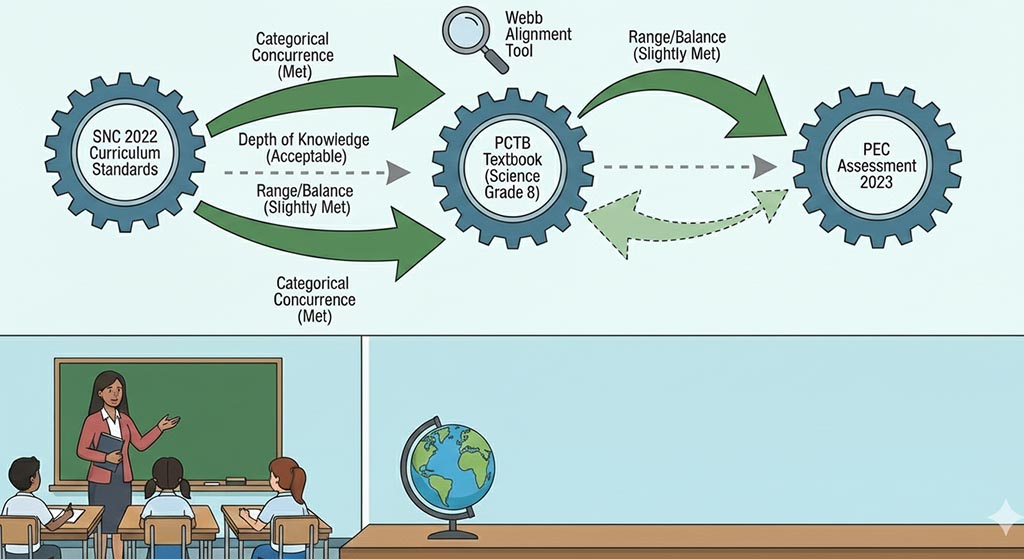
Standard-based curriculum enhances quality and coherence of educational outcomes to gauge the alignment between standards and assessment to meet the diverse needs of learners. The Single National Curriculum (SNC) 2022 was developed and implemented to provide quality education aimed at unifying and standardizing education across Pakistan in line with the fourth goal of Sustainable Development Goals (SDGs). The current study was descriptive to explore the alignment between curriculum standards and assessment of 8th-grade science. The sources of data were SNC 2022 science grade VI-VIII, a textbook of Punjab Curriculum and Textbook Board (PCTB) and Punjab Examination Commission (PEC) assessment test. The Webb Alignment Tool was used to measure the level of alignment on four criteria: categorical concurrence, range of knowledge, Depth of Knowledge (DOK) consistency, and balance of representation. The results of the study revealed that the assessment met the criteria of categorical concurrence whereas depth of knowledge consistency was at an acceptable level. The assessment slightly meets the criteria of balance of representation and range of knowledge even at a minimum acceptable level. Furthermore, there is a less good degree of alignment between SNC 2022 science SLOs and PEC assessment 2023. Furthermore, 84% of assessment items were of DOK level-l and level-2 and only 16% of items of DOK level-3 and level-4 were included.
References
Anderson, L. W. (2002). Curricular alignment: A re-examination. Theory into Practice, 41(4), 255-260. https://doi.org/10.1207/s15430421tip4104_9
Tian, P. (2024). Alignment between curriculum standards and assessment in understanding chemical reaction principles at upper-secondary schools. Journal of Baltic Science Education, 23(3), 550-569. https://doi.org/10.33225/ jbse/24.23.550
Artika, W., &Nurmaliah, C. (2023). Improving Critical Thinking Skills Through Higher Order Thinking Skills (HOTS)-Based Science. International Journal of Instruction, 16(4), 283-296. https://doi.org/10.29333/iji.2023.16417a
Ziebell, N. and Clarke, D. (2018). Curriculum alignment: performance types in the intended, enacted, and assessed curriculum in primary mathematics and science classrooms. StudiaPaedagogica, 23(2), 175. https://doi.org/10.5817/sp2018-2-10
Baker, E. L. (2005). Aligning curriculum, standards, and assessments: Fulfilling the promise of school reform. InC. A. Dwyer (Ed.), Measurement and research in the accountability era (pp. 323-344). Routledge.
Zhao, L., Zhao, B., & Li, C. (2023). Alignment analysis of teaching–learning-assessment within the classroom: How teachers implement project-based learning under the curriculum standards. Disciplinary and Interdisciplinary Science Education Research, 5(1), 5-13. https://doi.org/10.1186/s43031-023-00078-1
Lopez, A. (2014). Alignment between standardized assessments and academic standards: the case of the saber mathematics test in Colombia.Revista RELIEVE, 19(2), 1-15. https://doi.org/10.7203/relieve.19.2.3026
Dickinson, E. R., Thacker, A. A., & Michaels, H.R., (2020). NGSS alignment: Where have we been and where are we going?.Educational Measurement Issues and Practice, 39(2), 31-34. https://doi.org/10.1111/emip.12331
Cheng, M. (2014). Encyclopedia of Science Education, In R. Gustone (Ed.), Alignment (pp-. ). Springer.
Barthakur, A., Joksimovic, S., Kovanovic, V., Richey, M., &Pardo, A. (2022). Aligning objectives with assessment in online courses: Integrating learning analytics and measurement theory. Computers & Education, 190.1-26.https://doi.org/10.1016/j.compedu.2022.104603
Bhola, D. S., Impara, J. C., & Buckendahl, C. W. (2003). Aligning tests with states' content standards: Methods and issues. Educational Measurement: Issues and Practice, 22(3), 21-29. https://doi.org/10.1111/j.1745-3992.2003.tb00134.x
Boeren, E. (2019). Understanding sustainable development goal (SDG) 4 on “quality education” from micro, meso and macro perspectives. International Review of Education, 65, 277–294. https://doi.org/10.1007/s11159-019-09772-7
Case, B., &Zucker, S. (2005a). Horizontal and vertical alignment. China at the China–US conference on alignment of assessments and instruction. Beijing: Pearson.
Cizek, G. J., Kosh, A. E., & Toutkoushian, E. K. (2018). Gathering and evaluating validity evidence: The generalized assessment alignment tool. Journal of Educational Measurement, 55, 477-512.https://doi.org/10.1111/jedm.12189
Eloff, I. (2024). Handbook on public policy and food security. In L. Sheryl, Hendriks& C. B., Suresh (Ed.), sustainable development goal 4: Quality education (pp. 120-130). Edward Elgar Publishing. https://doi.org/10.4337/9781839105449.00017
Gilbert, J. (2004). The RoutledgeFalmer Reader in science education. London: Routledge.
Government of Pakistan. (2014). Punjab curriculum and textbook board. Curriculum implementation framework Punjab-2014. Lahore: School Education Department Government of Punjab.
Government of Pakistan. (2022). Single National curriculum 2022 science grade VI-VIII. Islamabad: Ministry of Federal Education and Professional Training. https://www.mofept.gov.pk/SiteImage/Misc/files/Draft%20Science%20SNC%20(6-8).pdf
Gulzar, K., &Mahmood, N. (2019). An analysis of alignment between secondary school mathematics standards and the assessments 2013 and 2014 of the board of intermediate and secondary education Lahore Punjab, Pakistan. Bulletin of Education and Research, 41(2), 11-26.
Herman, J. L., & Webb, N. M. (2007). Alignment methodologies. Applied Measurement in Education, 20(1), 1-5. https://doi.org/10.1080/08957340709336727
Houff, S. (2012). Instructional alignment: Optimizing objectives, methods, and assessment for developing unit plans. R & L education. https://www.amazon.com/Instructional-Alignment-Optimizing-Objectives-Assessment/dp/1607094533
Liu, J., Ma, Y., Sun, X., Zhu, Z., &Xu, Y. (2021). A systematic review of higher-order thinking by visualizing its structure through histcite and citespace software. The Asia-Pacific Education Researcher, 31(6), 635-645. https://doi.org/10.1007/s40299-021-00614-5
Qhibi, A., Dhlamini, Z. B., &Chuene, K. (2020). Investigating the strength of alignment between senior phase mathematics content standards and workbook activities on number patterns. Pythagoras, 41(1), 2-16. https://doi.org/10.4102/pythagoras.v41i1.569
Ziebell, N. and Clarke, D. (2018). Curriculum alignment: performance types in the intended, enacted, and assessed curriculum in primary mathematics and science classrooms. StudiaPaedagogica, 23(2), 175-203. https://doi.org/10.5817/sp2018-2-10
Liu, X., Fulmer, G. (2008). Alignment between the science curriculum and assessment in selected NY state regents’ exams. Journal of Science Education and Technology, 17, 373-383. https://doi.org/10.1007/s10956-008-9107-5
Liu, X., Zhang, B., Liang, L. L., Fulmer, G., Kim, B., & Yuan, H. (2009). Alignment between the physics content standard and the standardized test: A comparison among the United States‐New York State, Singapore, and China‐Jiangsu. Science Education, 93(5), 777-797. https://doi.org/10.1002/sce.20330
Mainali, B. P. (2012). Higher order thinking in education. Academic Voices: A Multidisciplinary Journal, 2, 5-10.https://doi.org/10.3126/av.v2i1.8277
Martone, A., & Sireci, S. G. (2009). Evaluating Alignment Between Curriculum, Assessment, and Instruction. Review of Educational Research, 79(4), 1332-1361. https://doi.org/10.3102/0034654309341375
Mat, H., & Mustakim, S. S. (2021). The effectiveness of virtual learning to enhance higher order thinking skills in year 5 students. International Journal of Academic Research in Business and Social, 11(6), 57-63. https://doi.org/10.6007/ijarped/v10-i2/10140
Mat, H., Mustakim, S. S., Razali, F., Ghazali, N., &Minghat, A. D. (2023). Exploring the need of teaching module for enhancing higher-order thinking skills. International Journal of Academic Research in Business and Social, 12(2), 1474-1489. https://doi.org/10.6007/ijarped/v12-i2/17342
McMaken, J., & Porter, A. (2012). The Surveys of Enacted Curriculum as a measure of implementation. In D. J. Heck, K. B. Chval, I. R. Weiss, & S. W. Ziebarth (Eds.), Approaches to studying the enacted mathematics curriculum (pp. 173-193). Charlotte, NC: Information Age.
Nasser, R., Zaki, E., Allen, N., Al Mula, B., Al Mutawaha, F., Al Bin Ali, H., & Kerr, T. (2014). Alignment of Teacher-Developed Curricula and National Standards in Qatar's National Education Reform. International Education Studies, 7(10), 14-24.http://dx.doi.org/10.5539/ies.v7n10p14
Penuel, W., Fishman, B., Gallagher, L., Korbak, C., & Lopez-Prado, B. (2008). Is alignment enough? Investigating the effects of state policies and professional development on science curriculum implementation. Science Education, 93(4), 656-677. https://doi.org/10.1002/sce.20321
Porter, A. C. (2002). Measuring the content of instruction: Uses in research and practice. Educational Researcher, 31(7), 3-14. https://doi.org/10.3102/0013189X031007003
Pryor, J., & Lubisi, C. (2002). Reconceptualising educational assessment in South Africa-testing times for teachers. International Journal of Educational Development, 22(6), 673-686. https://doi.org/10.1016/S0738-0593(01)00034-7
Roach, A. T., Niebling, B. C., &Kurz, A. (2008). Evaluating the alignment among curriculum, instruction, and assessments: Implications and applications for research and practice. Psychology in the Schools, 45(2), 158-176. https://doi.org/10.1002/pits.20282
Saido, G., Siraj, S., DeWitt, D., & Al-Amedy, O. (2018). Development of an instructional model for higher order thinking in science among secondary school students: A fuzzy Delphi approach. International Journal of Science Education, 40(8), 847-866. https://doi.org/10.1080/09500693.2018.1452307
Schmidt, W. H., C. C. McKnight, R. T. Houang, H. C. Wang, D. E. Wiley, L. S. Cogan, & Wolfe, R. G., (2001). Why schools matter: Cross-national comparison of curriculum and learning. San Francisco: Jossey-Bass. https://www.amazon.com/Why-Schools-Matter-Cross-National-Comparison/dp/0787956848
Siddiqui, S. (2016). Education policies in Pakistan: Politics, projections, and practices. Oxford University Press. https://www.amazon.com/Education-Policies-Pakistan-Projections-Practices/dp/0199402078
Squires, D. (2012). Curriculum alignment research suggests that alignment can improve student achievement. The Clearing House: A Journal of Educational Strategies, Issues and Ideas, 85(4), 129-135. https://doi.org/10.1080/00098655.2012.657723
Sulaiman, T., Muniyan, V., Madhvan, D., Hasan, R., & Rahim, S. S. A. (2017). Implementation of higher order thinking skills in teaching of science: A case study in Malaysia. International research journal of education and sciences,1(1), 2550-2158.
Surya, A., Sularmi, S., Istiyati, S., Rukayah, R., &Poerwanti, J. (2019). Skills of elementary school teachers in developing mathematics questions based on higher-order thinking skills (HOTS). Journal of Physics Conference Series, 1318(1), 21-38. https://doi.org/10.1088/1742-6596/1318/1/012138
UNICEF. (2000). Defining quality in education. The International Working Group on Education Florence. Italy: United Nations Children’s Fund, 1-43.
Webb, N. L. (1997). Criteria for alignment of expectations and assessments in mathematics and science education. Research Monograph No. 6. Washington, DC: Council of Chief State School Officers.
Webb, N. L. (2005). Webb alignment tool. Retrieved from Wisconsin Center of Education Research University of Wisconsin-Madison: http://watv2.wceruw.org/
Webb, N. L. (2007). Issues related to judging the alignment of curriculum. Applied Measurement in Education, 20(1), 7-25. https://doi.org/10.1080/08957340709336728
Wilson, D. and Narasuman, S. (2020). Investigating teachers' implementation and strategies on higher order thinking skills in school based assessment instruments. Asian Journal of University Education, 16(1), 70-84.https://doi.org/10.24191/ajue.v16i1.8991
Yeung, S. Y. S. (2015). Conception of teaching higher order thinking: perspectives of Chinese teachers in Hong Kong. The Curriculum Journal, 26(4), 553-578. https://doi.org/10.1080/09585176.2015.1053818
Yu, J., Li, C., & Li, G. (2022). Alignment between biology curriculum standards and five textbook editions: a content analysis. International Journal of Science Education, 44(14), 1-20. https://doi.org/10.1080/09500693.2022.2119621
Downloads
Published
How to Cite
Issue
Section
License
Copyright (c) 2026 Bulletin of Education and Research

This work is licensed under a Creative Commons Attribution-NonCommercial-ShareAlike 4.0 International License.